
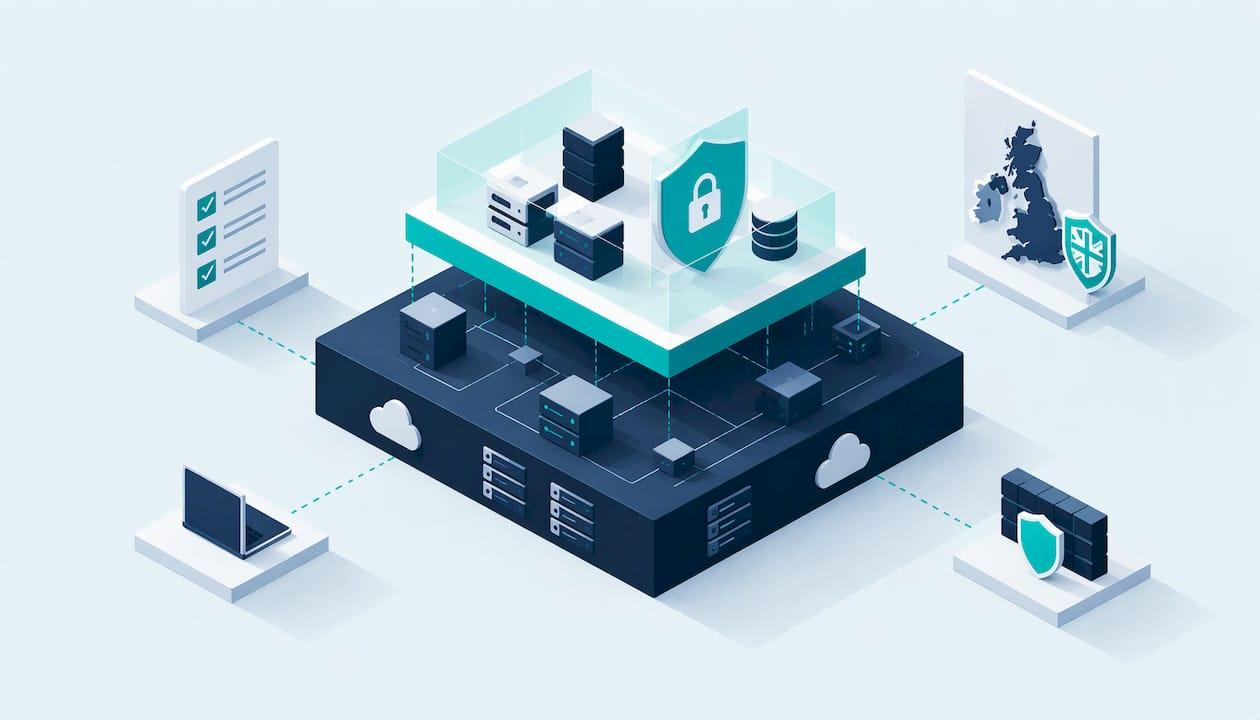
An AWS penetration test is an authorised, hands-on attempt by a qualified tester to break into the parts of your AWS account that you are responsible for: your identity and access settings, storage, servers, networks and the applications running on them. AWS lets you test most mainstream services without asking permission first, but you must stay within its policy and stay out of AWS's own infrastructure. The value comes from scoping it properly and from a report you can act on. At Solusec, our CREST-accredited testers work with you directly, so the scope is agreed with the person who will actually do the testing, and our cloud security assessment for AWS and Azure is built around that.
This guide is for startups, small businesses, schools, colleges and charities that run workloads on AWS and need to know what a test involves, what to prepare and what happens afterwards.
Key Takeaways
- AWS publishes a list of Permitted Services you can test without prior approval, but testing AWS's own infrastructure is prohibited and denial-of-service style testing is not allowed.
- You are responsible for security in the cloud (configuration, access, data, your code), so that is what a test should target.
- Get written authorisation and a clear scope before anything starts. In the UK, unauthorised access is a criminal offence under the Computer Misuse Act 1990.
- Good preparation (accounts, IP addresses, contacts, a stop plan) saves days of testing time and avoids false abuse reports.
- A test is only finished when findings are fixed and retested, and for many organisations it also supports Cyber Essentials and similar requirements.
Table of Contents
- What an AWS penetration test actually covers
- What AWS lets you test, and what it does not
- Shared responsibility decides your scope
- An AWS security testing checklist to prepare
- Tools, and why tools alone are not enough
- From findings to fixes
- How AWS testing fits with Cyber Essentials
- What a Solusec AWS test gives you
- How often to test
- FAQ
- Sources
What an AWS penetration test actually covers
A vulnerability scan runs automated checks and lists what it finds. A penetration test goes further: a person chains weaknesses together to show what an attacker could really reach. If you want the detail on that difference, our page on penetration testing versus vulnerability scanning sets it out.
On AWS, the work usually falls into a few areas:
- Identity and access (IAM). Over-generous roles, access keys left in code, and permissions that let a low-privilege user become an administrator. In most cloud breaches this is where the real damage happens, because one stolen key can open far more than one server.
- Storage. Buckets or snapshots that are public or shared more widely than intended, and data that is not encrypted.
- Compute. Internet-facing servers and containers with missing patches, weak settings or exposed management ports.
- Networking. Security groups that allow more inbound traffic than the service needs, and routes between environments that should be separate.
- Serverless and APIs. Functions with excessive permissions and APIs that trust input they should check.
- Applications. Your own web application, which is often the easiest way in. Our web application and API testing covers that layer.
- Monitoring. Whether anyone would notice the test, which tells you whether you would notice a real attacker.
Not every business needs all of this. A small company with one web application on a couple of EC2 instances needs a tighter scope than a SaaS provider with dozens of accounts. The aim is proportionate testing of what an attacker could reach, not the longest possible list.
What AWS lets you test, and what it does not
AWS's penetration testing policy says customers can run security assessments or penetration tests without prior approval against a defined list of Permitted Services. The list includes Amazon EC2 instances, NAT Gateways, Elastic Load Balancers, Amazon RDS, Amazon CloudFront, Amazon Aurora, API Gateway, AWS Lambda, Amazon Elastic Container Service, AWS Fargate and others. The same page is where to check the current list, as AWS updates it.
The same policy is equally clear about limits:
- You may not carry out security assessments of AWS's own infrastructure or the AWS services themselves.
- If you find a security issue in an AWS service during testing, you must report it to AWS Security straight away.
- Services outside the Permitted Services list need a conversation with AWS first. The UK Ministry of Justice's developer guidance, for example, notes that services such as ElastiCache or ECR require notifying AWS.
- Network stress testing is restricted. The same guidance records that EC2 testing must not generate traffic above 1 Gbps or 1 Gpps in aggregate for more than a minute.
In practice this means a test plan should name each service in scope, check it against the live AWS list, and exclude anything that would amount to a denial-of-service exercise. Your tester should do this checking as part of scoping, not leave it to you.
Authorisation is a legal matter in the UK
The Computer Misuse Act 1990 makes unauthorised access to computer systems an offence. A penetration test is lawful because the system owner has agreed to it in writing. That means the person signing the authorisation must genuinely own or control every account, IP address and domain in scope. If a third party hosts part of the system, or an agency set up the AWS account for you, confirm who actually holds the authority before testing begins.
Shared responsibility decides your scope
AWS secures the underlying cloud: the data centres, hardware and the services themselves. You secure what you build and configure on top. That is why a test targets your settings, your access rules and your code rather than AWS.
The same logic applies when someone else runs the platform. The Ministry of Justice's guidance for teams on a shared platform says the scope of an independent technical health check should include the web application and any cloud configuration written as code, and must not stray into the platform provider's responsibilities. It also says testers normally work with the same level of access the service team already has. That is a useful model for any organisation: define who owns each layer, and test only your layer.

If you want a plain walk-through of how to draw those boundaries, our guide to scoping a penetration test goes through six steps for the person who has to approve the work.
An AWS security testing checklist to prepare
This is the preparation list we would want a client to work through before a test. Much of it is also a quick self-check you can run any time.
Agree the scope in writing
- List every AWS account, region and service in scope, and everything explicitly out of scope.
- Name the type of test: external only, authenticated, or assumed-breach where the tester starts with a normal user's access.
- Agree a schedule, including any freeze periods such as exams, payroll runs or fundraising campaigns.
- Record who can authorise the test and who can stop it.
- Agree what happens if the tester finds evidence that someone else has already broken in.
Check the basics yourself first
- IAM: remove unused users and access keys, switch on multi-factor authentication for every human user, and check that no one uses the root account for daily work.
- Storage: review which buckets are public and why, and confirm encryption settings.
- Compute: confirm patching status and that management ports (SSH, RDP) are not open to the whole internet. AWS's own auditing guidance asks you to review security groups so inbound traffic is restricted by port, protocol or source IP.
- Networking: check that development and production are properly separated.
- Serverless: check each function's role has only the permissions it needs.
- Monitoring: confirm CloudTrail logging is on and that someone receives alerts.
Fixing the obvious issues first is not cheating. It stops the test spending its time on problems you already know about, so the tester can look for the subtle ones.
Prepare the practical details
If testing traffic originates from AWS-hosted machines, AWS's own guidance on running penetration testing workloads on AWS recommends static Elastic IP addresses, reverse DNS on each address, and sharing the address range with target security teams so they can allow it. It names four common causes of false abuse reports: shared or rotating source IP pools, stale target addresses, reports triggered by automated detection at the target, and testing traffic that cannot be identified. Telling your own security contacts and any managed provider in advance avoids a real incident response being triggered by a planned test.
Tools, and why tools alone are not enough
Open-source tools such as Prowler, ScoutSuite and Pacu are widely used in cloud testing. Broadly, the first two report on configuration and posture, while Pacu is aimed at exploiting weaknesses once found. They are useful, but they produce long lists without telling you which issues matter together. A scanner can tell you that a role is permissive. It will not tell you that the permissive role, the exposed web form and the unencrypted backup combine into a route to your customer data.
That chaining is where an experienced tester earns their fee, and it is the reason the report matters more than the tool output. Ask any provider who will be doing the hands-on work, and what their report will look like.
From findings to fixes
A useful report ranks findings by what an attacker could actually do with them, not just by a generic severity score. A sensible way to act on it:
- Fix first what is easy to reach and costly if abused. An exposed storage bucket holding personal data comes before a low-risk header issue.
- Remove the cause, not just the symptom. If one access key was in code, check how many others are, and change the process that put it there.
- Group quick wins. Many findings are single setting changes you can make in one afternoon.
- Plan the harder items. Redesigning network segmentation or permission structures needs an owner and a date.
- Retest. A retest confirms the fixes work and did not open something new. Ask for it to be included when you agree the scope.
For smaller organisations the biggest risk is a report that lands and then sits unread. Plain-English findings with proportionate recommendations make the difference, and at Solusec the findings come from the testers themselves rather than from a sales team.
How AWS testing fits with Cyber Essentials
Cyber Essentials is the UK government-backed baseline scheme, and schools, charities and suppliers to larger organisations are increasingly asked for it. If you run servers on AWS that you manage yourself, they are part of your scope for the scheme, as your responsibility rather than AWS's. Cyber Essentials Plus adds hands-on technical verification on top of the self-assessed standard. Our comparison of Cyber Essentials and Cyber Essentials Plus helps you decide which you need.
A penetration test is a separate, deeper exercise, but the two support each other: certification sets the baseline, and a test shows how well that baseline holds under real attack. If you are working towards certification quickly, Solusec's Cyber Essentials certification is priced from £320 to £600, a gap analysis is £300, and urgent turnaround is an extra £100. Education customers can see the Cyber Essentials for schools page.
What a Solusec AWS test gives you

Solusec is a CREST-accredited provider, and our testers and assessors deal with you directly in plain English. For AWS, we start from your scope and what you are responsible for, then test your cloud configuration and the applications and servers running on it. You receive clear, proportionate recommendations you can act on, with hands-on remediation support available for SMEs, schools and charities.
Published starting points for related work are £3,000 for an external IP test and £2,500 for a CMS website test. Cloud scope varies with the number of accounts and services, so we agree it with you before any work begins. Talk to us about your AWS environment, or see infrastructure and network testing if your servers sit beyond the cloud as well. If a deadline is pressing, there is also urgent penetration testing at short notice.

For SaaS companies answering customer security questionnaires, our page on penetration testing for SaaS providers explains how test evidence is typically used. If you also use Google Cloud, see our guide to Google Cloud penetration testing, or Azure penetration testing for Microsoft environments.
How often to test
Test after major changes: a new environment, a migration, a new customer-facing application or a significant change to access. Many organisations also test once a year as a baseline, and teams that release often may prefer regular penetration testing or continuous penetration testing. The right rhythm depends on how fast your AWS estate changes, so a quick conversation about your release pattern is a good place to start.
FAQ
Do I need AWS permission before penetration testing my AWS account?
Not for the services on AWS's Permitted Services list, which includes EC2, RDS, Lambda, CloudFront and API Gateway. Services outside that list need you to contact AWS first. You should still have written authorisation from your own organisation and a clear scope, and your tester should check the current list on AWS's policy page before starting.
Can a penetration test take my AWS systems offline?
Testing is planned to avoid disruption, and denial-of-service testing is prohibited under AWS's policy. Some risk can never be removed entirely, so agree a schedule, a contact who can stop the test, and which systems are most sensitive. Testing against a staging copy is also an option for fragile services.
What is the difference between AWS penetration testing and an AWS security checklist?
A checklist reviews settings against known good practice and is something you can run regularly yourself. A penetration test adds a human tester who tries to exploit weaknesses and chain them together, showing what an attacker could actually reach. They work best together: the checklist keeps the basics tidy between tests.
Does AWS penetration testing count towards Cyber Essentials?
No, they are separate. Cyber Essentials is a certification covering a defined set of technical controls, and servers you manage on AWS fall within its scope. A penetration test is a deeper, separate exercise. Many organisations do both, using certification as the baseline and testing to see how it holds up.
How long does an AWS penetration test take?
It depends on the number of accounts, services and applications in scope. A small, well-prepared environment can be tested far faster than a sprawling one. Your tester should give you an estimate once the scope is agreed, and good preparation is the most effective way to keep it short.
Sources
- Penetration Testing, Amazon Web Services
- Security testing and ITHC, Ministry of Justice Developer Portal
- Best practices for running penetration testing workloads on AWS, AWS re:Post
- Auditing Security Checklist for Use of AWS
- Computer Misuse Act 1990, legislation.gov.uk
Recommended
- From £2,500: 2026 UK penetration testing costs and checklist
- External Attack Surface Management: A Practical UK Guide
- Rapid7 vs Qualys: Which Vulnerability Scanner Fits a UK SME?
- Google Cloud penetration testing: scope, rules and cost
This article was created with assistance of AI. We never use AI with your data unless given explicit permission.