

A penetration testing report is the formal record of what testers found when they attacked your systems on purpose, and the only thing that matters is whether it gives decision-makers evidence they can trust and remediation steps they can act on immediately. Every credible report should map its findings against a recognised rating system such as CVSS, follow a consistent structure like the OWASP Penetration Test Reporting Standard (OPTRS), and ideally come from a CREST-accredited tester. If it doesn’t do that, treat it as a list of scary words, not a security document.
TL;DR:
A credible penetration testing report must follow recognized standards like CVSS, OPTRS, and be from a CREST-accredited tester to be truly trustworthy.
Reports should include a clear findings summary table, detailed step-by-step reproduction instructions, CVSS scores, business impact, and remediation guidance with effort estimates.
Test scope, methodology, and phases must be explicitly documented to ensure the report’s validity, with structured data formats enabling automation into vulnerability management systems.
Different readers require tailored sections: executives focus on risk and impact, while technical teams need detailed findings prioritized by severity.
Trust signals like adherence to OPTRS, CVSS transparency, and CREST accreditation separate genuine reports from generic checklists or incomplete documents.
Table of Contents
-
What standards and trust signals separate a good report from a template dump?
-
Get a CREST-accredited report built for action, not just compliance
Types and formats of penetration test reports
Not every report is written for the same reader, and confusing the formats is a common mistake. A consultancy typically produces a full technical report, a condensed executive summary, and sometimes a standalone technical appendix, because a finance director and a systems administrator need entirely different things from the same test.
The type of engagement also shapes the document. A compliance-driven test (for something like Cyber Essentials) reads differently to a red-team exercise designed to simulate a real attacker, and a purple-team engagement produces a more collaborative deliverable that walks defenders through detection gaps rather than just listing holes, according to CREST’s threat-led testing guidance.
Increasingly, reports also arrive as structured data:
-
Full narrative report for auditors, insurers, and technical leads who need every detail
-
Executive summary (two to four pages) for boards and non-technical stakeholders
-
Technical appendix with raw tool output, request/response pairs, and payloads
-
Machine-readable export, typically JSON, aligned to OPTRS for import into a vulnerability management system
That last format matters more than it sounds. A pentest report example built on OPTRS lets a security team pull findings straight into Jira or a VMS platform without manually retyping severity ratings and descriptions, which is where a lot of remediation delay actually comes from.
What should a penetration testing report include?
A useful penetration test report template follows a predictable order, and if a report you’ve received skips any of these, ask why.
1. Executive summary. This should cover business impact in plain English, what was and wasn’t tested, and the top three to five findings ranked by risk. OWASP’s Web Security Testing Guide is explicit that this section exists for people who will never read a CVSS vector string.
2. Scope and methodology. Exact test dates, in-scope targets, the rules of engagement, whether testing was authenticated or unauthenticated, and the tools and manual techniques used. NIST SP 800-115 frames this against four standard phases: planning, discovery, attack, and reporting, and a report that doesn’t say which techniques covered which phase is harder to trust.
3. Findings summary table. A single table showing counts by severity (critical, high, medium, low, informational) gives readers the shape of the problem before they read a single detail.
4. Detailed findings, each with:
-
A unique ID and descriptive title
-
CVSS score and vector string
-
Business impact in one or two sentences
-
Step-by-step reproduction instructions
-
Evidence (screenshots, request logs, code snippets)
-
Remediation guidance with an estimated fix effort
5. Risk-rating rubric explaining how severity was assigned, so two testers using the same method reach comparable conclusions.
6. Remediation plan and retest criteria, stating what “fixed” looks like and how it will be verified.
7. Appendices with raw scanner output, CVE references, and the test checklist used.
Pro Tip: If a vendor’s sample report buries remediation advice inside a paragraph rather than giving it its own labelled field per finding, that’s a sign their reporting process wasn’t built around helping you fix things quickly.
A sample penetration test report is worth reading in full precisely because it shows this structure in practice: a master findings table up front, then per-finding detail, then appendices for scope and methodology.
How should you read and act on a pentest report?
Different readers should start in different places, and trying to read a 60-page technical report cover-to-cover is how findings get lost.
-
Executives read the summary only, focusing on business impact and the headline risk count.
-
Technical teams jump straight to detailed findings, working from critical severity downward.
-
Project managers use the findings table to triage: exploitability first, then exposure (internet-facing versus internal), then business impact.
-
Everyone cross-references remediation guidance against the retest criteria before marking anything closed.
Triage works best when findings get converted into tickets immediately, tagged with the CVSS score and linked back to the report finding ID. That link matters later, because when a retest happens, evidence of the fix needs to trace back to the exact issue it resolves, not just a generic “patched” comment.
What standards and trust signals separate a good report from a template dump?
A report’s credibility rests on whether it’s built on recognised methodology rather than a generic checklist copied between clients.
-
CVSS vector strings (something like
AV:N/AC:L/PR:N/UI:N/S:U/C:H/I:H/A:H) tell you exactly how a score was calculated, covering attack vector, complexity, privileges required, and impact, which is essential for consistent prioritisation according to SANS. -
NIST SP 800-115 structures testing into planning, discovery, attack, and reporting phases, giving you a way to check whether a methodology section is genuinely comprehensive or just a paragraph of buzzwords.
-
CREST accreditation means the firm and its testers have been independently assessed against a recognised quality bar, rather than self-certifying their own competence.
-
Evidence integrity should mean reproducible steps, human review on anything rated critical or high, and disclosure of confidence scores where a finding couldn’t be fully verified, a standard set out in OWASP’s APTS reporting requirements.
Reports built around a consistent, standards-aligned format cut the friction of pulling findings into ticketing systems, which is exactly what OPTRS was designed to solve.
Turning findings into a remediation and retesting plan
A report that sits in an inbox achieves nothing. The findings need owners, deadlines, and a way to prove the fix worked.
-
Sort findings into a simple matrix: quick wins (low effort, high impact), moderate fixes, and major remediation projects needing budget or architecture change.
-
Assign an owner and a deadline to every finding, not just the critical ones, and log it in your ticketing or vulnerability management system.
-
Define what closes a finding. A patch note isn’t evidence; a retest confirming the exploit path no longer works is.
-
Track recurring findings across engagements. If the same misconfiguration class reappears every year, that’s a process failure, not a testing failure, and it’s the clearest signal a continuous penetration testing model would catch it earlier.
Pro Tip: Keep a running log of every “quick win” fix time across engagements. If your average keeps shrinking, that’s the single best metric to show a board that security spend is working.
What CREST-accredited reporting typically looks like
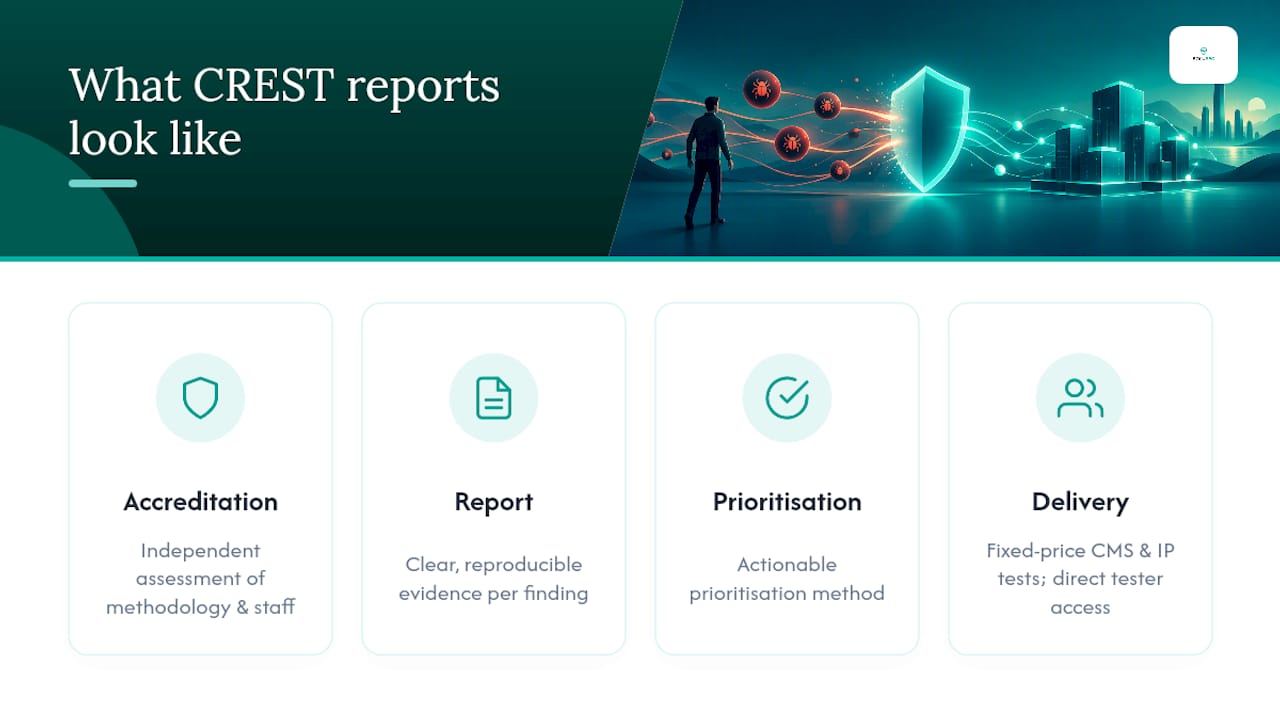
CREST accreditation means a firm’s testing methodology, reporting standards, and staff competence have been independently assessed, not just claimed on a website. That distinction matters when you’re relying on a report to satisfy an insurer, a client, or a board.
A report from a properly accredited provider should give you clear, reproducible evidence for every finding, a prioritisation method you can actually apply, and a defined path to retest once fixes go in. Solusec works this way for startups, small businesses, schools, and charities: fixed-price CMS website tests and external IP tests, delivered with direct access to the tester who did the work rather than a sales layer in between.
Where most penetration testing reports fall down
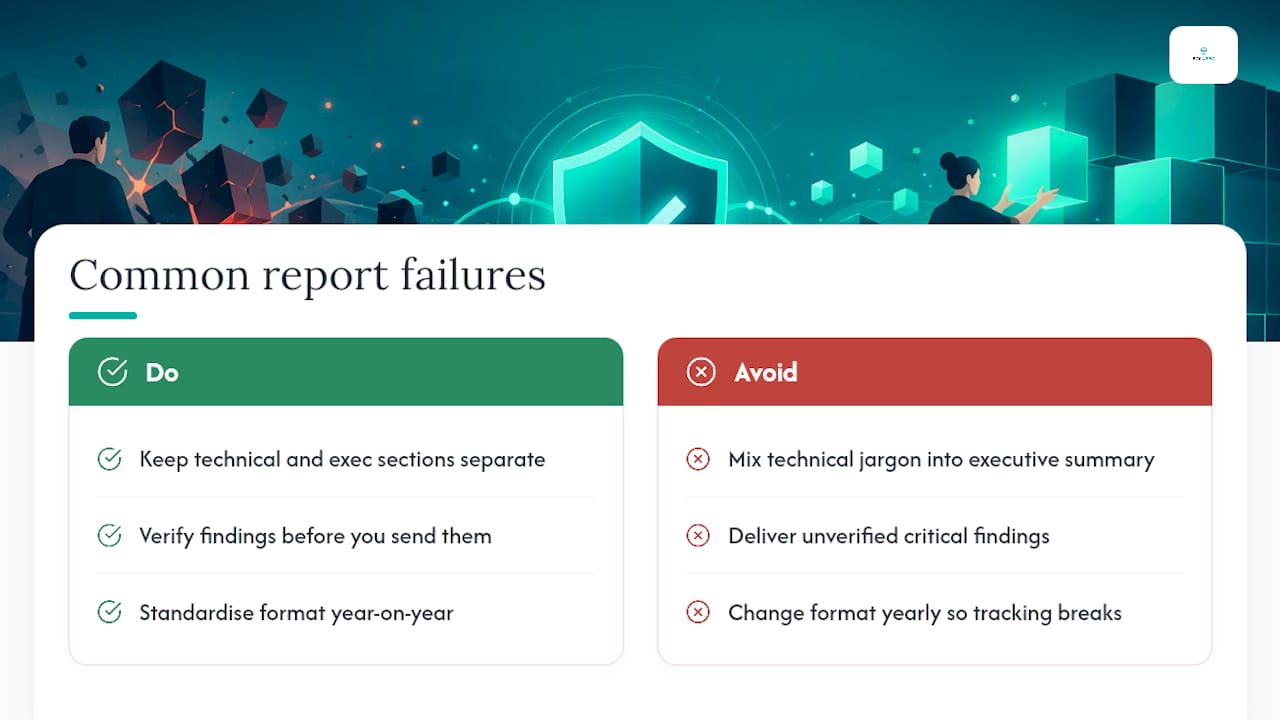
The biggest mistake I see is mixing audiences: technical jargon buried in the executive summary, or business impact statements missing entirely from the technical findings. Keep them properly separate.
The second is unverified findings. A critical rating that turns out to be a false positive on delivery destroys trust in the whole document. Verify before you send it, and standardise your format year on year so remediation tracking actually means something over time.
Get a CREST-accredited report built for action, not just compliance
Some businesses prefer providers that deliver reports a technical team can act on quickly and a board can understand easily, without a sales team managing the relationship. Every engagement is delivered by a CREST-accredited tester directly, with clear evidence, prioritised findings, and retest options built in rather than sold as an add-on later.
Solusec’s fixed-price CMS website test runs at £2,500 and the external IP test at £3,000, both delivered one-off with a full report and remediation guidance included. If certification is the goal rather than a standalone test, Cyber Essentials starts from £320 depending on organisation size, with a £100 urgent turnaround fee if you’re working against a deadline. Get in touch through the penetration testing page to scope a fixed-price test and see exactly what your report will contain before you commit.
Where to read the standards and a sample report in full
-
OPTRS: the machine-readable reporting schema itself
-
OWASP WSTG reporting guidance: the source for executive/technical structure
-
NIST SP 800-115: the testing-phase methodology reference
-
APTS reporting requirements: evidence and verification standards
-
A public sample report: full structure in practice
Sources
FAQ
Can you provide an example of a penetration test report?
Yes. A public sample penetration test report shows the standard layout: a findings summary table, detailed per-finding sections with reproduction steps, and appendices covering scope and methodology. Reviewing one before you commission a test helps you brief a provider on the level of detail you expect.
What are the five stages of penetration testing?
Most methodologies follow planning, discovery, attack, and reporting, as set out in NIST SP 800-115, though some frameworks split these into five stages by separating reconnaissance from scanning. The reporting phase is where findings, evidence, and remediation guidance get formally documented.
What is a CVE report?
A CVE (Common Vulnerabilities and Exposures) entry is a publicly catalogued, standardised identifier for a known vulnerability, not a report in itself. A penetration testing report will often reference specific CVE numbers inside individual findings to show a vulnerability is documented and understood industry-wide.
Is penetration testing illegal?
Penetration testing is legal in the UK when carried out with explicit written authorisation from the system owner, defined through a scope and rules of engagement agreed before testing starts. Testing systems without that authorisation, even with good intentions, can breach computer misuse laws, which is why every report should document the authorised scope clearly.
Recommended
This article was created with assistance of AI. We never use AI with your data unless given explicit permission.