
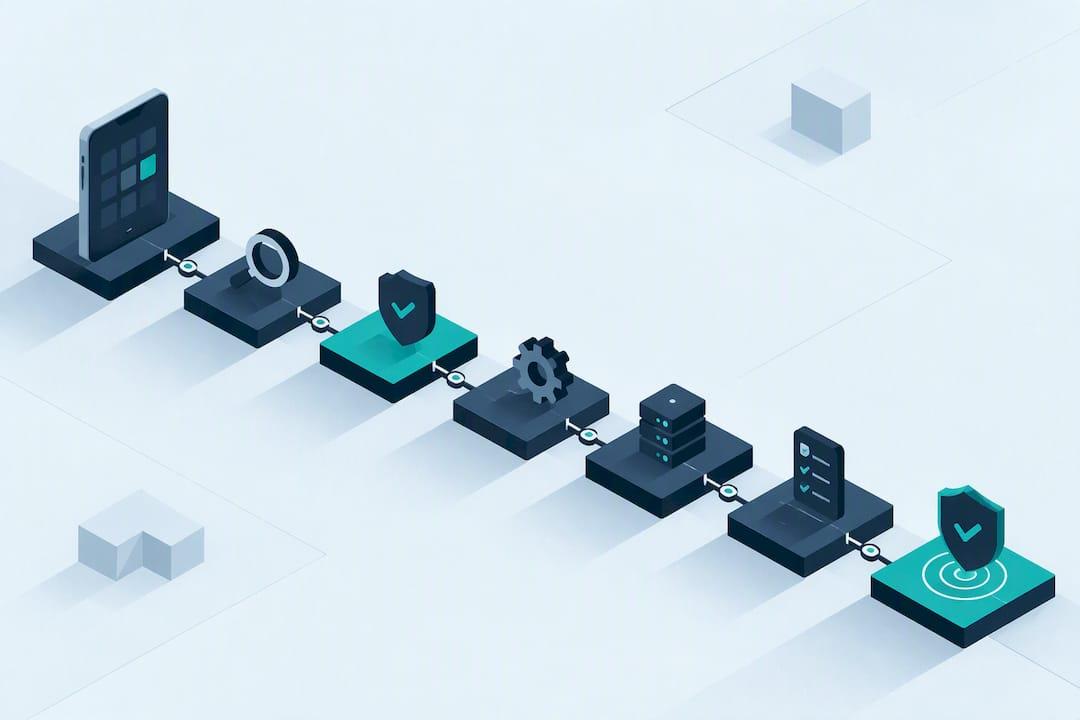
Mobile app penetration testing is an adversary-simulating assessment that probes a mobile application, its backend APIs and its platform-specific storage and communication for exploitable weaknesses. Expect a structured lifecycle of scoping, testing, reporting and follow-up remediation, carried out under written authorisation by qualified testers, ideally working to CHECK or CREST standards. A credible engagement ends with evidence-backed findings, not just a vulnerability list.
Key Takeaways
Mobile application security testing must follow a structured lifecycle evaluated against established standards to effectively identify exploitable vulnerabilities and ensure comprehensive protection.
| Point | Details |
|---|---|
| Proper scoping prevents gaps | Defining clear boundaries and objectives for testing ensures all critical areas are covered without overspending. |
| Human validation is essential | Automated scanners accelerate scanning but cannot replace expert review and verification during testing. |
| Scope should include backend and third-party integrations | Testing should extend beyond the app binary to include APIs, cloud services, and SDKs for full security insights. |
| Standards provide consistent benchmarks | Frameworks like OWASP MASVS and MASTG guide thorough testing and help evaluate tester competence. |
| Partner with accredited testers like Solusec | Working with CREST-certified providers ensures expert execution, clear communication, and reliable results. |
Table of Contents
- The testing lifecycle: prepare, map, test, exploit, report, retest
- Choosing the right scope: client only, client and API, or full stack
- Which standards and checklists set the bar
- Writing the statement of work and picking a provider
- Concrete tests and the vulnerabilities they uncover
- Report anatomy, severity and what to demand before signing off
- From one-off tests to continuous assurance
- Why accredited testers and tester experience matter
- Getting a mobile app tested properly
- Sources
- FAQ
The testing lifecycle: prepare, map, test, exploit, report, retest
A mobile pentest follows a predictable sequence, and understanding each stage helps you judge whether a supplier's workplan and schedule are realistic.
- Scoping: the tester and client agree objectives, boundaries, builds under test, test accounts and data, and a resource-day estimate. NCSC guidance treats this as the most important phase, since poor scoping produces tests that are either too broad to finish on budget or too narrow to catch critical issues.
- Reconnaissance and mapping: testers enumerate the app's attack surface, including API endpoints, third-party SDKs, push notification services and any embedded web views, building a map of what actually needs probing rather than relying on the app's own description of itself.
- Execution: this is where static analysis (SAST), dynamic analysis (DAST), binary analysis and runtime instrumentation happen. Testers decompile or instrument the app, intercept traffic, and attempt to exploit weaknesses they find rather than simply flagging them.
- Validation and evidence: a competent report backs every finding with a proof of concept that another engineer can reproduce, alongside a risk rating that reflects real-world exploitability, not just a scanner's default severity.
- Follow-up and retest: closure criteria are agreed up front, findings are tracked through to fix, and retesting confirms the fix actually works before the item is closed in your vulnerability management process.
MASTG stresses that automated scanners speed up the mapping stage but cannot replace human-led validation, since tools generate false positives and miss issues that only become exploitable when chained together. A supplier quoting a flat day count with no mention of validation or retest is skipping half the job.
Choosing the right scope: client only, client and API, or full stack
The biggest scoping decision is how far past the app binary the test reaches. Client-only testing (just the installed app, storage and local logic) is cheaper and faster but misses the backend issues that usually cause the worst breaches, since most mobile apps are thin clients over an API that does the real work.
- Client plus API testing covers the app binary and the backend endpoints it talks to, which is the minimum scope for most organisations given how much business logic now lives server-side.
- Full-stack testing adds cloud infrastructure, admin consoles and any internal services the backend depends on, appropriate when the app handles regulated data or high-value transactions.
- Android and iOS differ enough in platform security model, so a like-for-like test usually needs separate effort for each, not a single quote covering "the app".
- Third-party SDKs, push services and cloud backends should be named in scope explicitly, since testers otherwise treat them as out of bounds and your report will have a blind spot exactly where many real breaches start.
- Source-code review (SAST) is worth requesting when you have access to the codebase and want deeper coverage of logic flaws; binary and reverse-engineering analysis is the fallback when only the compiled app is available, such as when testing a third-party vendor's app.
Decide scope before asking for quotes, because the difference between client-only and full-stack testing changes both price and what the report can actually tell you about your risk.
Which standards and checklists set the bar
Several reference frameworks exist so you are not relying on a tester's memory for what "thorough" means.
- The OWASP MASVS defines mobile security control groups, covering storage, cryptography, authentication, network communication and resilience against tampering, and is the standard against which coverage should be measured.
- MASTG documents the specific techniques testers use to verify each MASVS control, from static analysis through dynamic testing to reverse engineering, and is useful as a checklist when reviewing a proposed test plan.
- NCSC guidance on penetration testing frames commissioning and recommends assured providers under the CHECK scheme, while stressing that a test is a snapshot in time rather than a guarantee.
- NIST SP 800-115 offers a complementary technical methodology for planning, executing and documenting the test itself, useful for shaping evidence standards in a statement of work.
- Tool categories worth knowing: static analysers for source or binary review, interception proxies for traffic analysis, and disassemblers or decompilers for reverse engineering. Each speeds up a specific stage, but none substitutes for a tester who understands exploitability and business context.
Pro Tip: Ask any prospective supplier to map their test plan against MASVS control categories by name, not just "OWASP Top 10 for Mobile", since the two are not the same thing and a vague answer is a warning sign.
Writing the statement of work and picking a provider
A clear statement of work prevents disputes later and keeps the test inside legal and practical bounds.
- Define scope precisely: list the app builds, platforms, test accounts, data sets and any systems explicitly out of scope, since ambiguity here is where most engagement disputes start.
- Specify test types: state whether SAST, DAST, binary analysis and backend API testing are all included, rather than assuming "penetration test" implies everything.
- Check provider qualifications: look for CREST accreditation, named tester CVs, and reference engagements; CHECK scheme participation matters if you are a public sector body or hold data that requires it.
- Confirm legal and safe-working terms: written authorisation, liability for disruption, and an agreed escalation path if a tester finds something critical mid-engagement, reflecting the requirements of the Computer Misuse Act 1990, which makes unauthorised access to a computer system an offence regardless of intent.
- Agree pricing basis: most quotes are built on resource days, driven by app complexity, platform count and whether backend infrastructure is in scope, so ask for the day count behind any headline price rather than comparing totals alone.
The requirement for signed, written authorisation before testing begins is not a formality. Under the Computer Misuse Act 1990, accessing a computer system without authorisation is an offence, which is precisely why the NCSC recommends working only with assured providers who document scope and permission before any testing starts.
Concrete tests and the vulnerabilities they uncover
A useful report maps straight back to recognised test categories, so you can judge whether a supplier actually covered the ground they claim to.
- Local data storage and insecure persistence: testers check what ends up in the iOS keychain, Android SharedPreferences, application sandboxes and local databases, since sensitive data left unencrypted on the device is one of the most common findings in mobile assessments.
- Cryptographic misuse: weak algorithms, hardcoded keys, and poor key management are tested because a cryptographic flaw often undermines every other control built on top of it.
- Authentication and session management: testers look for weak session tokens, missing lockouts, and logic flaws that let one account act as another, usually proven with a working exploit rather than a theoretical description.
- Transport security: certificate pinning implementation and bypass techniques are checked, since an app that trusts any certificate is trivially exposed to interception on an untrusted network.
- Runtime tampering, hooking and reverse-engineering resistance: testers attempt to hook into running processes, bypass jailbreak or root detection, and modify app behaviour at runtime, which matters most for apps handling payments or regulated data.
Some vulnerabilities only become genuinely risky when chained together: a minor storage weakness combined with a session flaw can escalate from low severity to a full account takeover. OWASP MASTG
This is why reviewers should read a report for exploit chains, not just a list of individually scored issues. A tester who only reports each finding in isolation misses the point: a low-severity local storage issue and a weak authentication flow might be trivial on their own but together give an attacker a path to full account compromise. Good reports explicitly call out these chains and explain the combined business impact, since a board reading a list of "medium" and "low" findings has no reason to act urgently unless someone connects the dots for them.
Report anatomy, severity and what to demand before signing off
A competent report is structured for two audiences at once: the people who need to understand business risk and the engineers who need to fix the problem.
- Executive summary: plain-English statement of overall risk posture and the handful of findings that matter most, written for someone who will never read the technical detail.
- Scope and methods: exactly what was tested, what wasn't, and which techniques were used, so the reader can judge coverage against the agreed statement of work.
- Findings with evidence: each issue documented with reproduction steps, screenshots or logs, and a clear description of business impact.
- Risk assessment: severity expressed using a recognised scheme, such as CHECK severity labels or CVSS scoring, alongside the exploitability and exposure context that a raw score misses.
- Remediation guidance: specific, actionable fix advice per finding, not a generic "patch your software" line.
CVSS gives a useful common language for severity, but its score alone does not capture how exposed or exploitable a finding is in your specific environment, which is why a good report layers business context on top of the raw number. Prioritise fixes by weighing exploitability, impact and exposure together rather than by score alone.
| Report element | What to look for |
|---|---|
| Executive summary | Plain-English risk statement for non-technical stakeholders |
| Findings | Reproducible evidence and business impact per issue |
| Severity | CHECK label or CVSS score plus exploitability context |
| Remediation | Specific fix guidance, not generic advice |
| Retest | Agreed closure criteria and a scheduled confirmation pass |
Retesting should be scoped and scheduled at the same time as the original engagement, with explicit closure criteria agreed in advance, so nobody is negotiating what counts as "fixed" after the fact.
From one-off tests to continuous assurance
A single annual test gives you a snapshot, but mobile apps ship updates far more often than that snapshot can keep pace with.
- SAST and automated checks fit earliest in the pipeline, catching coding issues before a build reaches a human tester.
- Gating rules should block releases on critical or high-severity findings and warn on medium ones, rather than treating every finding as a release blocker.
- Cadence typically means a full pentest before a major release, lighter sanity checks on interim builds, and a scheduled full retest at a sensible interval, alongside continuous testing for apps that change frequently.
- Adversary simulation (red teaming) is worth considering once basic hygiene is solid, since it tests detection and response as well as technical weaknesses, which a standard pentest does not.
Why accredited testers and tester experience matter
The quality gap between suppliers is rarely visible in a proposal document, it shows up in how findings are validated and explained.
- CREST accreditation signals that an organisation's testing methodology and tester competence have been independently assessed, rather than self-declared.
- Solusec is a CREST-accredited organisation providing expert-led penetration testing and cybersecurity certification services.
- Clients dealing directly with testers rather than a sales layer get findings explained in plain language, with proportionate advice rather than a generic scanner printout.
- Annual penetration testing and continuous penetration testing are both delivered on this basis, giving organisations a choice between periodic and ongoing assurance models.
Getting a mobile app tested properly

Working directly with CREST-accredited testers means the person writing your report is the same person who ran the test, not a sales contact relaying someone else's notes. Solusec's penetration testing services cover mobile, web, infrastructure and cloud, with annual and continuous engagement models depending on how often your app changes.
- Have your app builds, test accounts and any third-party SDKs listed before you get in touch, since this shortens the scoping conversation considerably.
- Identify your technical contact for the engagement, as testers will need someone who can answer questions about backend architecture quickly.
- Decide roughly which scope you want tested, client-only, client plus API, or full stack, so the first conversation can focus on detail rather than starting from zero.
Get in touch through the penetration testing page to request a scoped estimate for your app.
Sources
FAQ
What is mobile app pentesting?
Mobile app pentesting is an authorised, adversary-simulating assessment of a mobile application, its local storage, and the backend services it talks to, aimed at finding exploitable security weaknesses. It typically follows a lifecycle of scoping, testing, reporting and retesting, as described in NCSC guidance.
Is pentesting illegal?
Pentesting itself is not illegal, but testing a system without the owner's written permission is an offence under the Computer Misuse Act 1990. Legitimate engagements always start with documented authorisation covering the exact scope being tested.
What are some good apps for penetration testing?
Testers typically rely on tool categories rather than a single app: interception proxies for traffic analysis, static analysers for source or binary review, and disassemblers for reverse engineering, as catalogued in MASTG. These tools support a qualified tester's analysis rather than replacing it.
What are some apps I should avoid having on my phone?
This article focuses on how organisations commission security testing for the apps they build or manage, not on rating specific consumer apps for personal use. The more relevant question for a security manager is whether an app you distribute or rely on has been tested against a standard such as MASVS.
Recommended
- How to Choose a Penetration Testing Provider
- Annual Penetration Testing
- Fixed-Price Penetration Testing
This article was created with assistance of AI. We never use AI with your data unless given explicit permission.