
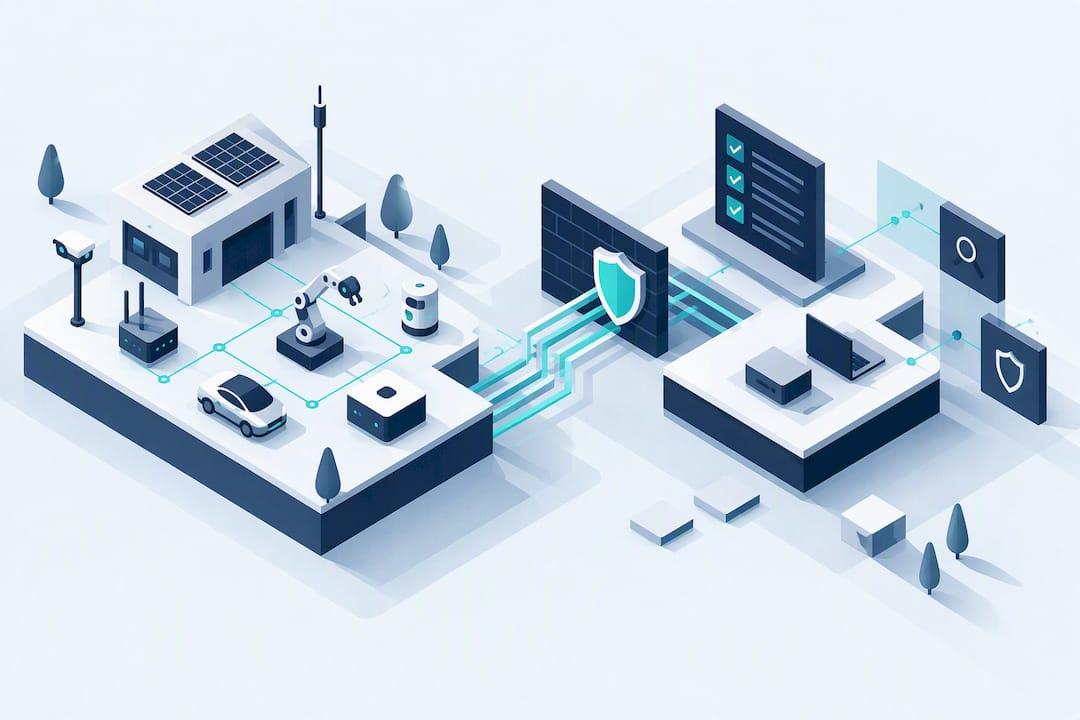
IoT penetration testing is a component-based security assessment that examines firmware, wireless interfaces, physical ports, backend APIs and companion apps as separate but related attack surfaces. Scope the device and its ecosystem first, pick a methodology such as the OWASP IoT Security Testing Guide, and commission a CREST-accredited tester when you need assurance that stands up to a client, regulator or insurer.
Key Takeaways
Effective IoT penetration testing requires component-based, thorough assessment across firmware, wireless, physical interfaces, and backend systems, with proper scoping, methodology, and remediation.
| Point | Details |
|---|---|
| Component-based testing | Test each device component individually, such as firmware, wireless, physical interfaces, and cloud backends, using specific categories. |
| Thorough scoping process | Define all assets, safety boundaries, timelines, evidence needs, and test models before engaging in testing. |
| Equipment varies by component | Use simple tools like a laptop for network tests and specialized hardware like logic analysers and RF snifters for physical and wireless testing. |
| Vendor collaboration crucial | Coordinate with manufacturers early, share scope, and obtain actionable reports rather than just certificates. |
| Solusec offers CREST-accredited testing | Solusec provides comprehensive IoT penetration testing, including network, firmware, and application assessments, with remediation support. |
Table of Contents
- What makes IoT penetration testing different from standard IT or web tests
- Component-based test methodology mapped to OWASP ISTG
- Typical engagement lifecycle, scoping essentials and expected deliverables
- Practical techniques and representative tools for firmware, hardware, wireless and network testing
- Training and certification: courses, learning paths and how to evaluate a provider
- Interpreting findings and prioritising remediation for IoT devices
- Practical commissioning checklist and Solusec's delivery model
- Detailed methodology for threat modeling specific to IoT environments
- Guidance on setting up a dedicated IoT testing lab environment
- Strategies for testing IoT cloud backend and API security
- Handling privacy concerns and data protection during penetration testing
- Coordination best practices with device manufacturers and stakeholders during and after testing
- Solusec services that deliver IoT testing outcomes and how to contact
- Authoritative standards and guidance to consult next
- FAQ
- Sources
What makes IoT penetration testing different from standard IT or web tests
A web application lives on a server with predictable compute, storage and patching cycles. An IoT device often runs on a constrained processor, a stripped-down Linux build or a real-time operating system, with limited memory for logging, encryption or intrusion detection. That gap between what a device needs to do securely and what its hardware can afford is the starting point for most IoT weaknesses, and it is why a web-focused test plan misses so much.
Connectivity compounds the problem. A single device might speak Wi-Fi to a home router, Bluetooth Low Energy to a phone app, and a proprietary radio protocol to a hub or gateway, each with its own authentication model and each worth testing independently. Attackers do not need network access at all in many cases: a device sitting on a shop counter, a meter on an outside wall or a sensor bolted to machinery can be opened, probed and reflashed by anyone with a screwdriver and a weekend. Supply chain risk follows the same logic. Firmware images, components and third-party libraries move through multiple vendors before reaching the end product, and a vulnerability introduced two suppliers back is still the device owner's problem.
Vendor paperwork helps but is not proof. NCSC guidance on vendor security assessment recommends combining a supplier's own evidence with independent lab testing and third-party assurance rather than accepting a security questionnaire at face value, and it specifically flags spot checks and automated lab tests as the way to validate claims a vendor makes about its own testing. That principle holds for IoT more than most categories, because the gap between a datasheet and a device's actual behaviour under test is often wide.
Component-based test methodology mapped to OWASP ISTG
The OWASP IoT Security Testing Guide organises test cases by component rather than by attack type, which is the structure most practitioners now plan against. Each component carries its own specialisation code and its own set of test categories, so a tester can select only the parts that apply to a given device rather than running a generic checklist.
The main components worth separating are:
- Firmware, where testers look for hard-coded secrets, outdated packages and missing exploit mitigations in compiled binaries.
- Wireless interfaces, covering Wi-Fi, Bluetooth, Zigbee or proprietary RF stacks, each with its own pairing and encryption behaviour.
- Physical interfaces, including exposed debug ports, removable storage and tamper protection on the enclosure.
- Network and cloud backends, where the device talks to APIs, MQTT brokers or cloud storage.
- Companion applications, mobile or web, that configure and control the device.
- Internal processing and communication buses, where one chip talks to another inside the same enclosure.
Within each component, the same test categories tend to recur: information gathering, authentication and authorisation, secrets management, cryptography, patch and update handling, business logic, and input validation. Firmware testing, for example, maps information gathering to identifying the bootloader and kernel version, secrets to searching extracted filesystems for embedded keys, and patch management to checking whether the update mechanism verifies signatures before flashing. OWASP's firmware test cases specifically call out binaries that lack standard protections such as PIE, ASLR or stack canaries, which raises the risk of memory corruption being exploitable once an attacker finds a bug.
Access level dictates what equipment a test needs. Remote and network-level tests need only a laptop and standard tooling. Local wireless tests often need a software-defined radio or a Bluetooth sniffer. Physical tests need a logic analyser, a set of probes and, for anything soldered down, a hot air station or a reflow setup.
Pro Tip: Run information gathering across every component before deciding where to spend the bulk of the engagement; a weak update mechanism found early often reshapes the whole test plan.
Typical engagement lifecycle, scoping essentials and expected deliverables
NCSC's penetration testing guidance describes a five-stage lifecycle that applies to IoT as much as any other target: initial engagement, scoping, testing, reporting and follow-up. IoT scoping has a few extra requirements that a web or infrastructure scope rarely needs.
- List every asset in the ecosystem, not just the device: firmware images, the companion app, cloud APIs and any hub or gateway in the chain.
- Agree safety boundaries up front, particularly for anything that controls a physical process, so testers know which actions could cause real-world harm.
- Set realistic timelines that account for hardware delivery, firmware extraction and any custom tooling the device's protocols demand.
- Specify what evidence the client needs, especially where the test will support a compliance claim such as a PSTI statement or an ETSI conformance assessment.
- Decide the test model, black-box, grey-box or white-box, based on how much documentation and source access the client can realistically provide.
During testing, fail-safe handling matters more here than in most engagements. A consumer device that locks up under fuzzing is an inconvenience; a safety-critical device that does the same during a live test can cause damage or injury, so testers plan isolated rigs and rollback procedures before touching production units.
Reporting should follow the same principle NCSC sets out for any engagement: severity ratings tied to real-world impact, proof-of-concept detail sufficient to reproduce the finding, and remediation advice specific enough for an engineering team to action. A retest, confirming that fixes actually closed the gap, is part of the deliverable, not an optional extra. Continuous testing arrangements suit devices that receive frequent firmware updates, since a one-off report ages quickly once the codebase moves on.
Practical techniques and representative tools for firmware, hardware, wireless and network testing
Each component calls for a different toolkit, and most IoT testing labs end up assembling a mix of software and inexpensive hardware rather than one all-purpose platform.
- Firmware: extract the image from flash or an update file, then run Binwalk to carve out filesystems and strings to surface embedded credentials, URLs or debug messages; follow up with static analysis of any compiled binaries to check for the exploit mitigations flagged in the OWASP firmware test cases.
- Hardware interfaces: identify JTAG, UART, SPI and I2C pins with a multimeter and a logic analyser, then use adapters such as a Bus Pirate or FTDI breakout to get a shell or dump memory directly, working on an isolated bench rather than a live production unit.
- Wireless: a low-cost software-defined radio covers basic signal capture and replay, while Bluetooth testing usually needs a dedicated sniffer and a protocol-aware fuzzer; renting specialist radio equipment makes sense for a one-off engagement rather than buying gear that will sit idle.
- Network, API and web: packet capture and a proxy such as Burp Suite cover traffic between the device, the app and the cloud, while API fuzzing tools probe the backend endpoints the device depends on for configuration and telemetry, an area OWASP's wireless and physical test cases treat as needing its own authorisation and input validation checks.
- Fuzzing and resource planning: protocol fuzzers take time to tune against a bespoke binary format, so budget engagement hours accordingly rather than assuming off-the-shelf fuzzers will find bugs on day one.
Hardware costs stay modest for most of this work. A logic analyser, a handful of adapters and a cheap SDR dongle cover the bulk of physical and wireless testing; the main ongoing cost is tester time spent reverse-engineering undocumented protocols.
Training and certification: courses, learning paths and how to evaluate a provider
IoT pentesting skills build in layers, and jumping straight to wireless or hardware work without the groundwork usually wastes lab time.
- Start with embedded Linux and C fundamentals, since most device firmware runs on one or both.
- Move to firmware reverse engineering, learning to extract, unpack and statically analyse images.
- Add hardware interfacing, practising with JTAG and UART on development boards before touching a client's device.
- Layer in wireless protocols, covering Wi-Fi, Bluetooth Low Energy and any RF standards relevant to your target devices.
- Finish with full-stack labs that combine firmware, hardware and network testing against a realistic device, which is closer to a real engagement than any single-skill course.
Course types vary. Lab-heavy courses in the style of SANS SEC556 push hands-on hardware and firmware work over lecture time, specialist certificates such as PIPA focus narrowly on IoT and hardware pentesting, and vendor-neutral workshops suit practitioners who want a broader survey before specialising.
When evaluating a provider, check that lab access is genuinely hands-on rather than video walkthroughs, that a physical hardware kit ships with the course rather than relying on simulators alone, that the syllabus has been updated for current firmware and protocol versions, and that there is a practical exam or assessed lab exercise rather than a multiple-choice test at the end.
Interpreting findings and prioritising remediation for IoT devices
A CVSS score alone rarely tells you how urgently to fix an IoT finding. A high CVSS score on a sensor that never leaves a locked cabinet carries less real risk than a medium score on a device with a public-facing API and a user base in the millions. Useful risk scoring for IoT layers exploitability, how many devices or networks the flaw can reach, and whether a successful exploit affects physical safety, not just data.
Remediation tends to repeat the same patterns across devices and vendors:
- Store secrets properly, moving hard-coded keys into a hardware security element or a securely provisioned store rather than the filesystem.
- Harden the update mechanism so firmware is signed and verified before it flashes, closing the gap that lets an attacker push malicious code.
- Remove or lock down debug interfaces such as exposed UART or JTAG headers before the device ships.
- Enforce secure boot so the device refuses to run unauthorised firmware at startup.
- Add telemetry monitoring so unusual device behaviour after deployment gets flagged rather than going unnoticed for months.
Vendor engagement matters as much as the technical fix. Ask suppliers for a published vulnerability disclosure policy, a stated minimum support period for security updates, both now required of consumer connectable products under the PSTI product security regime, and evidence that they run their own automated testing rather than relying solely on a one-off assessment.
Pro Tip: Ask a vendor for their last penetration test report, not just a compliance certificate; a certificate confirms a process happened, a report shows what was actually found.
Practical commissioning checklist and Solusec's delivery model
Before signing off a test, confirm scope covers every asset in the device ecosystem, agree physical and network access in advance, set safety boundaries for anything safety-critical, define test depth against OWASP or ETSI test cases, and lock in a retest window once fixes land.
Solusec runs CREST-accredited penetration testing, including a fixed-price external IP test for network-facing components, alongside hands-on remediation support once findings land. For organisations choosing between building internal IoT testing capability and commissioning external accredited testers, the deciding factor is usually frequency: a one-off product launch generally suits an external engagement, while a continuous product line benefits from recurring testing built into the development cycle.
Detailed methodology for threat modeling specific to IoT environments
Threat modelling an IoT device starts with mapping the full data flow, not just the device itself: sensor or actuator, local processing, wireless link, gateway or hub, cloud backend, and companion app. Each hop is a trust boundary, and each boundary needs its own set of questions about who can read, write or inject data at that point.

A useful structure borrows from STRIDE but applies it per component rather than per system. Spoofing matters most at pairing and authentication points, such as Bluetooth bonding or API tokens. Tampering matters most at firmware update mechanisms and at any exposed physical interface. Repudiation matters where telemetry or logs feed into compliance or safety decisions. Information disclosure risk concentrates in unencrypted radio traffic and in cloud storage misconfiguration. Denial of service risk is often higher on constrained devices, since a flood of malformed packets can crash a process that has no spare memory to recover gracefully. Elevation of privilege typically appears where a local interface, once it is accessible, grants root or firmware-flashing rights with no further authentication.
Physical access deserves its own line in the model, since IoT devices are frequently deployed somewhere an attacker can simply pick them up. Treat the enclosure, the debug ports and the storage chip as a trust boundary in their own right, separate from the network-facing attack surface, and model what an attacker gains at each stage: board access, chip-off extraction, firmware in hand, then credentials or keys recovered from that firmware. That staged view usually produces a more useful test plan than a single generic risk register.
Guidance on setting up a dedicated IoT testing lab environment
A workable IoT lab does not need a large budget, but it does need a few things a standard web testing setup lacks. Start with an isolated network segment, ideally air-gapped from production systems, so devices under test cannot reach or be reached by anything else. A managed switch with port mirroring lets you capture traffic without disrupting the device's own connections.
For hardware work, a dedicated bench with anti-static matting, a decent soldering and hot air station, and a set of probes and adapters for JTAG, UART, SPI and I2C covers most physical interface testing. A logic analyser earns its cost quickly once you are decoding unfamiliar protocols, and a bench power supply with adjustable voltage and current limiting protects both the device and the tester from damage during probing.

Wireless testing needs its own RF-aware space where possible, since dense Wi-Fi or Bluetooth traffic from neighbouring equipment can mask the signal you are trying to capture. A Faraday enclosure is worth the investment for any lab doing regular wireless work, though renting one for a single engagement is often more practical than buying.
Keep a library of known-good firmware images and configuration backups for every device the lab works on, so a bricked unit during testing does not end the engagement. Version control for extracted firmware, scripts and findings keeps repeat engagements on the same device line consistent, and a simple asset register stops test hardware disappearing between projects.
Strategies for testing IoT cloud backend and API security
Most IoT devices are only as secure as the backend they report to, and that backend is usually a standard web API wearing a different hat. Start by mapping every endpoint the device calls, including ones that only fire during provisioning or firmware updates, since those are often tested less rigorously than the main control API.
Authentication and session handling deserve close attention. Many devices authenticate to the cloud with a static key baked into firmware rather than a per-device credential issued at setup, which means extracting one device's firmware can compromise every unit from the same production batch. Check whether the API enforces per-device rate limiting, since a single compromised device should not be able to pull data for an entire fleet.
MQTT brokers and other publish-subscribe protocols need their own test pass separate from REST APIs. Check topic-level access control, since a poorly configured broker can let one device subscribe to another's data stream. Standard API fuzzing and proxying tools cover the REST side effectively, but MQTT, CoAP and similar IoT-specific protocols usually need protocol-aware tooling rather than a generic web proxy.
Finally, test what happens when the device goes offline and reconnects. Session resumption, token refresh and queued command delivery are common weak points, since developers tend to test the happy path far more thoroughly than the reconnection logic that handles real-world network drops.
Handling privacy concerns and data protection during penetration testing
IoT devices often collect more personal data than their function suggests, location, usage patterns, audio or video, and a pentest that handles that data carelessly creates its own compliance problem. Agree data handling terms as part of scoping, before any testing starts, covering what personal data testers may encounter, how it will be stored during the engagement, and when it will be deleted afterwards.
Where a device captures audio, video or biometric data, treat any test data captured during the engagement as sensitive by default, rather than assessing it case by case once testing is under way. Extracted firmware sometimes contains real user data from a manufacturer's test or demo environment, which testers should flag rather than retain beyond what the report needs as evidence.
Cloud backend testing carries its own privacy exposure, since API testing can incidentally expose other customers' data if the backend has weak tenant isolation. Agree in advance how the testing team will handle a discovery like that: stop testing immediately, document the finding without further probing, and notify the client through an agreed emergency contact rather than continuing to explore the extent of the exposure.
Finally, keep test findings, firmware extracts and captured traffic on encrypted storage for the engagement's duration and delete them on an agreed schedule once the report is delivered and accepted, rather than leaving sensitive extracts sitting on a tester's laptop indefinitely.
Coordination best practices with device manufacturers and stakeholders during and after testing
Testing a device you do not manufacture means coordinating with a vendor who may not expect, or welcome, close scrutiny of their product. Set expectations early: share the scope and the categories of testing planned, without necessarily revealing every technique, so the manufacturer understands the engagement's boundaries and can flag anything genuinely unsafe to test.
Establish a single point of contact on both sides before testing starts, so a critical finding, such as a flaw that could be exploited in the field right now, reaches someone who can act on it without delay. Agree how urgent findings will be communicated, by phone rather than email, for example, and what counts as urgent enough to interrupt the test to report immediately.
After testing, structure the handover so the manufacturer's engineering team receives findings in a form they can act on: clear reproduction steps, affected firmware versions, and remediation guidance specific to their architecture rather than generic advice. Where the device is being assessed for a compliance claim, such as evidence supporting an IASME Cyber Assurance submission, make clear which findings block the claim and which are lower priority.
Retesting closes the loop. Agree a retest window as part of the original engagement rather than negotiating it after the report lands, and treat the retest as confirmation that fixes work as intended, not as a second full assessment. Where the relationship is ongoing, such as a device line receiving quarterly firmware updates, a lighter continuous testing arrangement usually serves both sides better than repeating a full engagement from scratch each time.
Solusec services that deliver IoT testing outcomes and how to contact
Commissioning IoT testing does not mean building an in-house lab before you can get a credible assessment. Some cybersecurity companies deliver CREST-accredited penetration testing with testers engaged directly rather than through a sales layer, which matters for IoT work where scope decisions, access arrangements and safety boundaries need technical back-and-forth rather than a templated proposal.

- Penetration testing covers the network, firmware and application components of a connected device ecosystem, scoped to the specific hardware and protocols involved.
- External IP test, a fixed-price engagement, suits the cloud and network-facing side of an IoT product where the backend API and gateway infrastructure need independent scrutiny.
- Cyber Essentials and IASME Cyber Assurance certification support manufacturers who need to evidence baseline security controls alongside technical testing, particularly where PSTI compliance statements are involved.
- Vulnerability management support keeps findings from a one-off test from going stale as firmware and backend code change.
Get in touch through Solusec's penetration testing page to scope an engagement, or start with Cyber Essentials certification if your immediate need is a recognised assurance baseline alongside technical testing.
Authoritative standards and guidance to consult next
For deeper technical reference, the OWASP IoT Security Testing Guide sets out the component-based test cases this article follows. ETSI TS 103 701 provides the conformance assessment methodology behind EN 303 645. NCSC's penetration testing guidance covers scoping and reporting expectations, and the PSTI product security regime sets the baseline legal requirements for consumer connectable products.
FAQ
What are the 5 C's of IoT?
Definitions vary across sources, and there is no single standardised framework universally cited as "the 5 C's of IoT" in security literature. Some use it to describe design principles such as connectivity, compute, communication, cost and power constraints, but readers should treat it as an informal shorthand rather than a fixed industry standard.
What are the 7 stages of penetration testing?
Frameworks vary by source, but NCSC guidance describes a five-stage lifecycle: initial engagement, scoping, testing, reporting and follow-up. Some providers break these stages down further into seven steps by splitting reconnaissance and exploitation out separately, but the underlying process is the same.
What does IoT stand for?
IoT stands for the Internet of Things, referring to physical devices, sensors and appliances that connect to a network and exchange data. In a security context, this covers everything from consumer smart home products to industrial sensors and connected medical devices.
What are the top 10 vulnerabilities in the IoT?
There is no single official ranked list specific to IoT devices cited consistently across sources, so avoid treating any particular list as a fixed standard. Commonly reported weaknesses include hard-coded credentials, insecure or unsigned update mechanisms, exposed debug interfaces, weak cloud API authentication and poor cryptographic practices, all of which the OWASP IoT Security Testing Guide test cases are built to detect.
Does Solusec test IoT devices specifically?
Solusec delivers CREST-accredited penetration testing and can scope engagements that cover the network and cloud-facing components of a connected device ecosystem, including a fixed-price external IP test. For manufacturer compliance needs, Cyber Essentials and IASME certification support can run alongside technical testing.
Sources
- Gov
- OWASP IoT Security Testing Guide
- ETSI TS 103 701 — Cyber security for consumer IoT: Conformance assessment (TS)
Recommended
This article was created with assistance of AI. We never use AI with your data unless given explicit permission.