
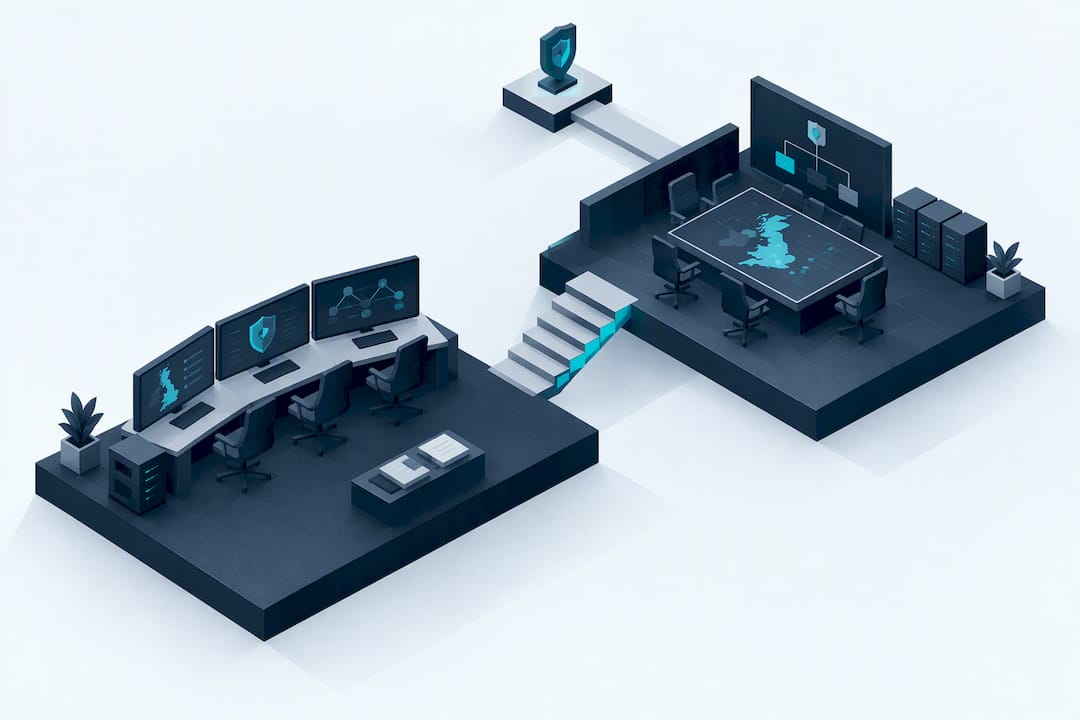
Effective incident response depends on a small set of defined roles rather than a single expert: an incident manager who coordinates, a technical lead who directs the fix, investigators and analysts who trace what happened, and IT or infrastructure staff who restore services. The NCSC frames this as a core team backed by extended stakeholders, with coordination kept separate from technical depth. For incidents beyond internal capacity, a qualified external supplier can supply that structure on demand.
TL;DR:
- Most organizations build a small core incident response team supported by extended roles for larger or more severe incidents.
- Clear decision-making levels are essential, with strategic, tactical, and operational roles defined to prevent confusion during an incident.
- Technical roles focus on containment, evidence collection, and system restoration, while the incident manager handles coordination and record-keeping.
- Non-technical teams such as Legal, PR, HR, and business continuity must have predefined decision boundaries to avoid delays during an incident.
- Regular training, deputy appointments, and pre-arranged external support options improve readiness and response effectiveness.
Table of Contents
- Core and extended incident response roles at a glance
- How incident command and executive ownership actually work
- What technical leads, investigators and infrastructure teams actually do
- Why the incident manager role is not a technical job
- What legal, communications, HR and continuity teams must own
- Keeping people and cover ready between incidents
- When to bring in an external incident response provider
- Where Solusec fits against this role model
- Where most incident response plans actually fall short
- Getting expert-led incident response support from Solusec
- Where to read the primary guidance
- Sources
- FAQ
Core and extended incident response roles at a glance
Most organisations build a cyber security incident response team, or CSIRT, around a small core group and draw on a wider circle only when needed. The NCSC's guidance on creating an incident response team sets out both layers and stresses that the exact mix should scale with the size of the organisation.
The core team typically includes:
- Incident manager or coordinator: owns the process, tracks actions and keeps a single authoritative record of what has happened.
- Technical lead or recovery manager: directs containment and recovery work and validates that fixes actually hold.
- Investigators and analysts: collect evidence, build a timeline and identify how the attacker got in.
- IT and infrastructure staff: apply containment measures, rebuild systems and restore services safely.
The extended team, brought in as the incident demands, usually covers:
- Senior executive or CEO: approves major decisions such as taking systems offline or paying for emergency support.
- Legal counsel: advises on regulatory reporting duties and evidence handling.
- Communications or PR: manages customer, media and staff messaging.
- HR: handles staff welfare, rostering and any internal misconduct angle.
- Business continuity and supplier or insurance contacts: keep critical services running and manage third-party dependencies.
In smaller organisations, one person often holds two or three of these roles at once, which is exactly why the NCSC guidance recommends naming deputies before an incident happens rather than during one.
How incident command and executive ownership actually work
Coordination during a live incident works best when it follows a command structure rather than an ad hoc chain of phone calls. The NCSC's guide on responding to cyber attacks describes a tiered model, often labelled Gold, Silver and Bronze, that separates strategic decisions from tactical coordination and operational execution.
- Gold (strategic): senior executives, usually including the CEO, who authorise disruptive actions, approve budget for emergency support and own external communications tone.
- Silver (tactical): the incident manager and senior technical leads, who translate strategic direction into a working plan and coordinate between teams.
- Bronze (operational): analysts, investigators and infrastructure staff carrying out containment, forensic collection and recovery tasks on the ground.
Decision authority needs to sit clearly at each level. Isolating a production system, approving a recovery order or issuing a public statement are Gold-level calls; the technical team should never be left guessing whether they have permission to pull a server offline. A single situational record, held by the incident manager, stops different teams from working off contradictory information as the picture changes.
Cadence matters as much as structure. Short, regular coordination meetings keep Gold and Silver aligned without pulling technical staff away from the work itself, and documented handovers at shift changes prevent detail being lost overnight. NCSC's capability guidance points to board-level exercises as the way to test whether this authority chain actually works before a real incident forces the question.
Pro Tip: Run at least one incident exercise a year that includes the board, not just the technical team, since a command structure only works if the people at the top have actually rehearsed using it.
What technical leads, investigators and infrastructure teams actually do
The technical roles carry different duties depending on where the incident sits in its lifecycle, and job specifications that ignore this tend to produce confusion about who owns what.
- Technical lead: triages the initial alert, weighs containment options, validates that an attacker has genuinely been locked out before recovery starts, and reports technical status to the incident manager.
- Investigators and analysts: collect forensic evidence, build a timeline of attacker activity, produce indicators of compromise and tactics for threat intelligence use, and hand findings to legal for regulatory reporting.
- IT and infrastructure staff: validate that backups are clean before restoring them, rebuild and patch affected systems, re-establish identity and access controls, and apply the containment measures the technical lead has signed off.
Mapped against the incident lifecycle, detection and analysis fall mostly to investigators and analysts, containment and eradication sit with the technical lead and infrastructure team working together, and recovery shifts weight back to infrastructure staff rebuilding services. Post-incident review pulls all three back in to compare what the runbook said should happen against what actually happened.
The NCSC's guidance on cyber incident response processes notes that investigation should ideally happen before systems are restored wherever possible, since early forensic findings shape both regulator reporting obligations and whether a rebuild is genuinely safe. Rushing recovery ahead of investigation is one of the more common ways organisations end up dealing with the same attacker twice.
Why the incident manager role is not a technical job
The incident manager's job is coordination, not deep technical expertise, and treating the two as interchangeable is a frequent source of confusion in smaller teams. The NCSC's team-creation guidance is explicit that this role tracks findings and actions, arranges updates and preserves a single authoritative record rather than performing forensic work itself.
- Operational administration: maintain the incident log, track open tasks against owners, escalate blockers and schedule status updates for Gold and Silver.
- Liaison management: decide when legal, PR, HR, insurers or law enforcement need to be pulled in, based on pre-agreed triggers rather than case-by-case debate mid-incident.
- Playbook ownership: keep the runbook current, covering contact lists, triage criteria, evidence handling steps and clear escalation thresholds.
A good playbook, per NCSC's guidance on cyber incident response processes, builds in contact redundancy: two contact methods and more than one named person for every critical role, so a single missed call does not stall the whole response.
Pro Tip: Write escalation triggers into the playbook as plain if-then statements ("if customer data is confirmed exfiltrated, notify legal within one hour") rather than leaving the call to judgement under pressure.

What legal, communications, HR and continuity teams must own
Non-technical functions are not passengers during an incident. Each one owns a specific decision area that the technical team needs to hand off to, and knowing the boundary in advance avoids delay when it matters.
- Legal: confirms reporting obligations, including any relevant to data protection or network and information systems rules, and directs evidence preservation so nothing is lost to a premature rebuild.
- Communications: agrees a single version of events across customer notices, staff briefings and media lines, and sets the threshold for escalating to a public statement.
- HR and welfare: manages rostering, arranges rest and rotation for staff working extended hours and watches for burnout in a response that runs beyond a day or two.
- Business continuity: maintains the priority order for critical systems, maps dependencies between them and coordinates with suppliers whose services sit on the critical path.
The UK Government Security Profession's incident response career profile reinforces this by describing the role as spanning communication and policy work alongside technical analysis, not one or the other.
Keeping people and cover ready between incidents
Every critical role needs a named deputy and an out-of-hours contact, and that list is only useful if it is kept current and genuinely accessible when someone needs it at short notice.
- Deputies for every critical role, reviewed whenever staff change, not just when an incident forces the gap into view.
- Shift patterns and handover templates for responses running beyond a single working day, so context does not evaporate between rotations.
- Enforced downtime, since a team working around the clock for days makes more mistakes, not fewer.
- Annual reviews and exercises, including secondments or on-the-job rotation, to surface capability gaps before a live incident does.
NCSC's collection on building and maintaining capability recommends this mix of exercising and review at least yearly, specifically to catch gaps that a purely technical audit would miss.
Pro Tip: Store the deputy and out-of-hours contact list somewhere accessible without network access, since a ransomware incident that takes down email is exactly when you need it most.
When to bring in an external incident response provider
Internal capability covers most day-to-day incidents, but certain thresholds point clearly towards external support: incident severity beyond what the team has handled before, gaps in specific technical skills such as forensic analysis, or a regulator or insurer requirement for independently verified evidence handling.
- Severity and scale: a breach affecting customer data or core operations across multiple systems usually justifies external help.
- Technical gaps: if nobody in-house has done live forensic collection under pressure before, that is a real constraint, not a minor one.
- Regulator or insurer conditions: some cyber insurance policies and regulatory expectations specifically call for independent evidence preservation.
An NCSC-assured CIR provider is expected to supply a named, accountable Team Lead, demonstrable forensic methodology, threat intelligence capability and a 24/7 contact route that can deploy quickly. Onboarding one into an existing incident command structure works best when the internal incident manager keeps ownership of the log and decision record, with the provider's Team Lead slotting into the technical lead function rather than replacing the coordination layer entirely. Choosing the right provider is worth doing before an incident, not during one; our guide to choosing a penetration testing provider covers much of the same vetting logic that applies to incident response suppliers.
Where Solusec fits against this role model
An organisation delivering incident response aligned with recognised standards may provide assurance that technical work follows an auditable standard. Work delivered directly by practitioners ensures that the person leading an engagement also handles the technical tasks. Familiarity with compliance requirements can help shape advice tailored to organisations without a large internal security team.
On an incident engagement, the service typically supplies an equivalent of a Team Lead alongside forensic analysts, with a knowledge transfer element aimed at improving the client's internal capability for future incidents.

Where most incident response plans actually fall short
The gap we see most often is not a missing tool or a weak playbook document. It is that nobody has rehearsed the handover between the technical team and the people with authority to approve a costly decision at 2am. Three fixes cover most of it: appoint deputies for every critical role now, run one board-level exercise this year, and update the playbook's escalation triggers before you need them, not after.
— Solusec Admin
Getting expert-led incident response support from Solusec
If your organisation is working through a live incident or wants a Team Lead and forensic capability on call before one happens, Solusec's incident response service is built to slot directly into the role model set out above, providing an accountable Team Lead, forensic analysis and knowledge transfer so your own staff gain capability rather than dependency.
Solusec's incident response service works best combined with internal ownership rather than replacing it: your incident manager keeps the log and the decision record, and Solusec's team fills the technical lead and investigator roles for the duration of the engagement.
- Rapid triage: an initial assessment to establish scope and severity before committing to a full engagement.
- On-call Team Lead: a named, accountable technical lead for the duration of the incident.
- Knowledge transfer: documentation and debrief aimed at strengthening internal capability, not just closing the ticket.
- Post-incident follow-up: many engagements pair well with a penetration test once systems are stable, to confirm the root cause is actually closed.
Contact a qualified provider to discuss your current setup and where an external Team Lead might fit against your existing roles.
Where to read the primary guidance
- Creating your cyber security incident response team, the NCSC's core and extended team structure.
- What to do when cyber attacks disrupt your organisation, the incident command model and decision authority.
- CIR Standard Level 2, what an assured incident response provider must demonstrate.
- The Network and Information Systems Regulations 2018, regulation 5, the statutory CSIRT designation.
Sources
- Creating your cyber security incident response team — NCSC
- What to do when cyber attacks disrupt your organisation — NCSC (PDF)
- CIR Standard Level 2 — NCSC (April 2023)
- The Network and Information Systems Regulations 2018 — regulation 5
FAQ
What are the 5 Cs of incident management?
Definitions of the "5 Cs" vary between organisations and training providers, and no single version is treated as canonical across the guidance referenced in this article. Rather than force-fit an unverified framework, it is more reliable to work from the core and extended role structure the NCSC sets out, which covers coordination, containment, communication and continuity in practical terms.
What do the P1 to P4 incident priority levels mean?
Incident severity is commonly graded in levels, with the highest severity indicating the most critical, business-disrupting issues and lower levels covering less urgent matters that can wait for routine handling. The exact thresholds for each level are not fixed by a single authority and are typically defined by each organisation's own incident management policy.
What are the typical steps in incident response?
Most incident response processes follow a cycle of preparation, detection and analysis, containment, eradication, recovery and post-incident review, a structure reflected throughout NCSC guidance. Different roles carry the weight at different stages: analysts lead detection, the technical lead and infrastructure team lead containment and recovery, and the whole team contributes to the review.
What are the main functions within incident command systems?
Incident command structures generally split into strategic, tactical and operational functions, often labelled Gold, Silver and Bronze, covering executive decision-making, coordination and hands-on technical work respectively. The NCSC's guidance on responding to cyber attacks describes this tiered approach as the way to keep authority and technical execution properly separated during a live incident.
Does Solusec provide a named Team Lead during incident response engagements?
Yes, Solusec's incident response service includes an accountable Team Lead for the duration of an engagement, in line with the CREST-accredited standards it works to. This person coordinates directly with the client's own incident manager rather than operating as a separate, disconnected function.
Recommended
- CREST vs CHECK: Which Do You Need?
- CMS Website Penetration Test
- Does My Small Business Need Cyber Essentials?
This article was created with assistance of AI. We never use AI with your data unless given explicit permission.