

CREST penetration testing means a security assessment carried out by a company and individual testers accredited against CREST’s technical and ethical standards, covering infrastructure, web, mobile, cloud, or AI systems. The accreditation confirms methodology and competence, not that any given engagement fits your assets. Before signing anything, check the provider’s accredited discipline on the CREST marketplace and demand a redacted sample report.
TL;DR:
Certification of individual testers, like the CREST CRT, demonstrates baseline competence but does not cover specialized areas like cloud identity or AI risks.
Accreditation for infrastructure testing does not automatically qualify a provider for web, mobile, or bespoke application security assessments.
Only when a provider’s discipline matches your specific assets—such as custom applications or cloud systems—can you ensure effective testing rather than relying solely on their CREST badge.
Procurement should verify the exact service discipline, named testers, and review sample reports to confirm practical testing capabilities before contracting.
A quality penetration test combines manual expertise with automated tools, includes clear scope, and delivers prioritized remediation plans with defined retest terms.
Table of Contents
-
What CREST penetration testing covers and how to match it to your assets
-
CREST certifications and tester competence: what CRT actually proves
-
How to choose a CREST-accredited penetration testing provider
-
Get a CREST-accredited test scoped around your actual assets, not a generic package
What CREST penetration testing covers and how to match it to your assets
CREST accreditation is not one blanket badge. It’s issued discipline by discipline, and the mistake many IT managers make is assuming a company accredited for infrastructure testing is automatically qualified to test a bespoke web application, a mobile app, or an AI model. It isn’t.
The accreditation spans several distinct service categories, and providers can hold some without holding others:
-
Internal and external network infrastructure testing
-
Web application testing (CMS platforms, custom-built apps, APIs)
-
Mobile application testing (iOS and Android)
-
Cloud architecture and configuration reviews
-
Datacentre and physical infrastructure assessments
-
Thick client and legacy system testing
-
The newer AI-enabled penetration testing annex, covering model and system-level AI risks
CREST-accredited testing can cover infrastructure, web and mobile applications, cloud architectures, datacentres, thick clients and mobile devices, but the right engagement depends on your assets and assurance objective, not the badge alone. An external IP test checks your perimeter, exposed ports, and internet-facing services. A CMS website test digs into application logic, authentication flows, and injection risks specific to platforms like WordPress or Drupal. If your business runs a customer-facing API or a workflow tool built in-house, neither of those generic categories quite fits. You need a provider whose accreditation and team experience explicitly cover application-layer testing of bespoke systems.
CREST certifications and tester competence: what CRT actually proves
Company accreditation and individual certification are two separate things, and buyers regularly conflate them. A firm can be CREST-accredited as an organisation while employing a mix of certified and uncertified staff on any given job, so ask specifically who is doing your test.
The CREST Registered Penetration Tester (CRT) qualification is the benchmark individual credential most testers hold at intermediate level. It’s a hands-on, practical exam covering:
-
Operating systems and common network services
-
Infrastructure vulnerability scanning and interpretation of results
-
Web application security fundamentals
-
Exploitation technique and reporting discipline
That threshold matters. It means a CRT holder has demonstrated competence across two technical domains, not just one.
Where CRT falls short is specificity. It doesn’t test cloud identity federation, container security, or adversarial AI prompt injection. If your engagement touches any of those, ask what additional certifications or hands-on experience the assigned testers bring, because certification level communicates baseline competence, not engagement-specific mastery.
CREST versus CHECK: which assurance route applies to you
Most commercial buyers never need CHECK, but it’s worth knowing the boundary so you don’t procure the wrong thing or get sold something you don’t need.
-
CHECK is NCSC’s scheme for government, public sector, and CNI. It’s aimed at authorised penetration testing of government, public-sector and critical national infrastructure systems, with clearance requirements, formal reporting obligations, and Cyber Essentials Plus as a prerequisite for testers. If your organisation sits inside that world, procurement mandates will likely specify CHECK explicitly.
-
CREST is the broader commercial accreditation route. For private-sector businesses, schools, charities, and SMEs, CREST accreditation is the natural choice and covers the overwhelming majority of security testing need without the clearance overhead CHECK carries.
-
Use a simple decision checklist. Ask whether your systems are classified or connect to government networks, whether a contract or regulator explicitly mandates CHECK, and whether your testers require security clearance to access your environment. If the answer to all three is no, CREST accreditation is almost certainly the right specification to write into your tender.
Getting this wrong rarely means an unsafe test. It usually means paying a premium for clearance and process overhead your business doesn’t need, or worse, discovering post-contract that your CHECK-mandated regulator won’t accept a CREST-only report.
What a robust CREST engagement actually looks like
A quality CREST engagement follows a recognisable shape: scoping and rules of engagement, discovery and reconnaissance, exploitation, post-exploitation and pivoting where safe to do so, and a reporting phase that explains business impact, not just technical findings.
Where cheaper engagements cut corners is the middle. CREST describes penetration testing as combining automated tools with manual techniques and exploitation expertise, and that combination is the whole point. Automated scanners are necessary but not sufficient. A scanner flags an outdated library or a missing header; a skilled tester chains that finding with a misconfigured permission and a weak credential policy to show how an attacker would actually reach sensitive data. Tools like intercepting proxies and browser-based kits, including the OWASP Penetration Testing Kit, support authenticated workflow testing and single-page application analysis, but they still need a human interpreting results and deciding what’s genuinely exploitable.
Before you accept a proposal, insist on these deliverables:
-
A redacted sample report showing structure, evidence quality, and writing standard
-
A remediation roadmap with prioritised, proportionate fixes, not a generic list
-
Clear severity rationale explaining why each finding is rated the way it is
-
Defined retest terms once fixes are applied
Evidence handling deserves a specific conversation too. Testing generates artefacts (screenshots, extracted data samples, session tokens) and you need clarity on how long these are retained, how they’re protected, and how they’re securely destroyed once the engagement closes.
Pro Tip: Ask your provider to walk through one real (anonymised) finding from a previous report, start to finish. How they explain the chain from discovery to business impact tells you more about their actual capability than any accreditation certificate.
How to choose a CREST-accredited penetration testing provider
Procurement is where most of the risk in this whole process actually sits, not in the testing itself. Work through these checks before you sign:
-
Confirm the exact company name and accredited service discipline on the CREST marketplace rather than trusting a badge on a website footer.
-
Ask which named testers will perform the work and sign off the report, and check their individual certification level against your specific technology stack.
-
Request a redacted sample report and read it properly. Look for evidence of manual validation, not just a list of scanner outputs with a company logo on top.
-
Ask directly about remediation priorities and retest terms before you get to the contract stage, not after the invoice arrives.
-
Confirm data handling, evidence retention periods, and cleanup procedures in writing.
Beyond the checklist, a few contractual items are easy to overlook and expensive to miss:
-
Scope definition precise enough to avoid disputes over what was and wasn’t tested
-
Whether out-of-hours or maintenance-window testing is included or charged separately
-
SLAs for report delivery and acceptance criteria for sign-off
-
Technology-specific vetting for APIs, cloud identity, mobile platforms, or AI systems if relevant to your environment
Red flags are usually easy to spot once you know to look. A scanner-only report dressed up with a company logo, testers who are never named, or a provider unwilling to share a sample report at all are all reasons to walk away. Legitimate accredited firms don’t hesitate on any of these points, and a good provider checklist will cover exactly this ground before you commit budget.
Typical timelines and what actually drives cost
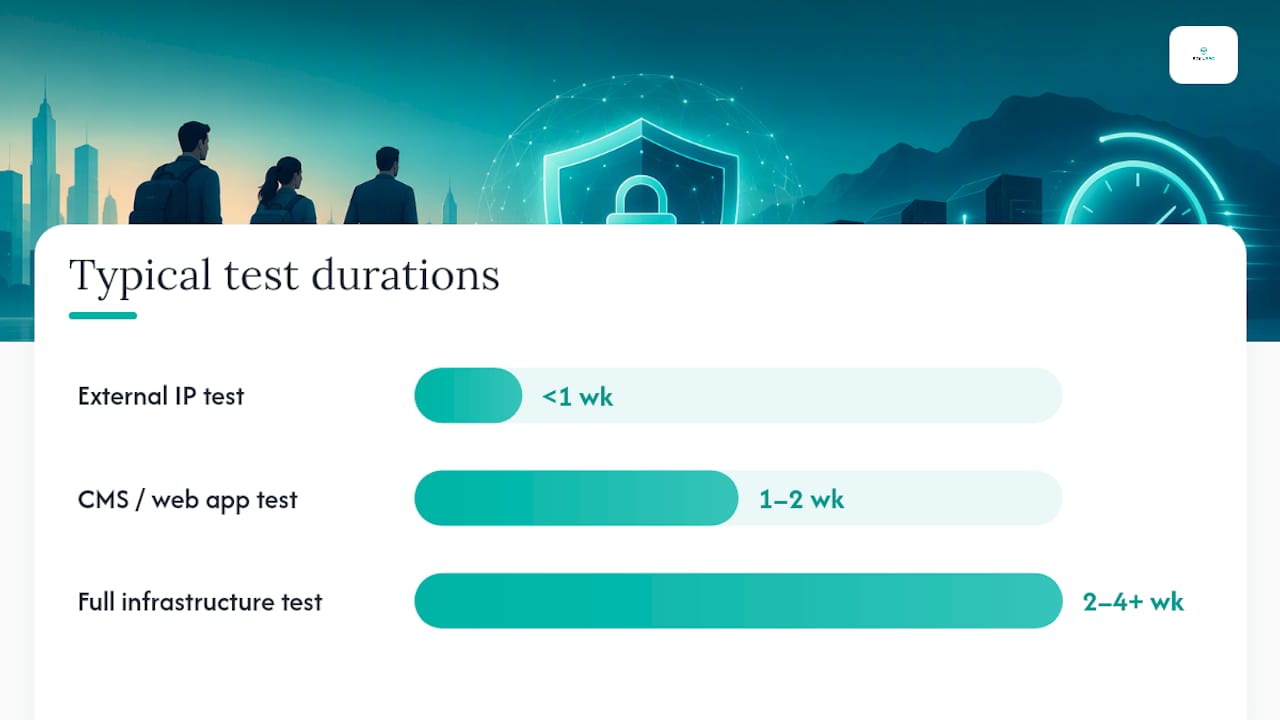
Scope size is the single biggest cost driver, followed closely by complexity. A single external IP range takes far less time than a sprawling internal network with dozens of segments, or an application with complex authenticated workflows.
Rough guidance for planning purposes:
-
External IP tests typically run under a week from kickoff to draft report
-
CMS or web application tests usually take one to two weeks depending on functionality depth
-
Full infrastructure engagements can run two to four weeks or longer for larger estates
Out-of-hours testing, specialist expertise (cloud identity, AI systems), and any clearance requirement all add time and cost. To keep budgets predictable, ask for fixed-price scoping wherever possible, consider staged assessments that test critical assets first, and set acceptance criteria upfront so there’s no ambiguity about what “done” looks like. Bundling a Cyber Essentials audit alongside a penetration test is often more efficient than commissioning them separately, since much of the scoping conversation overlaps.
What procurement teams consistently get wrong
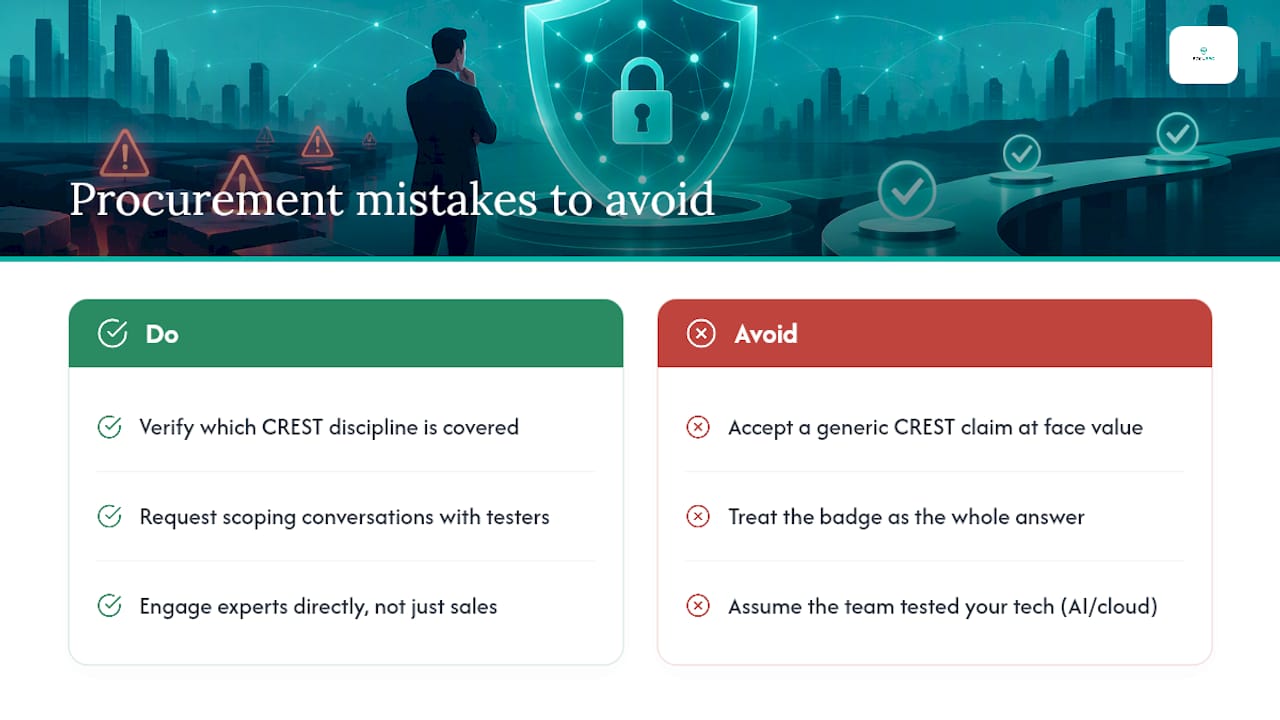
The most common mistake isn’t picking a bad provider. It’s accepting a generic “CREST accredited” claim at face value without checking which discipline it actually covers, then discovering mid-engagement that the team has never tested an AI system or a cloud-native application before. Accreditation reduces that risk, but only when buyers actually verify it rather than treating the badge as the whole answer.
Experts often work directly with startups, schools, and charities on exactly this kind of scoping conversation, delivered by testers rather than a sales layer.
Get a CREST-accredited test scoped around your actual assets, not a generic package
Some CREST-accredited providers offer an alternative to bigger consultancies for organisations that want a test scoped to what they actually run, not a templated package sold by an account manager who’s never touched a terminal. Many engagements are delivered and signed off by named, certified testers, with pricing options that can be fixed price rather than opaque day-rate quotes.
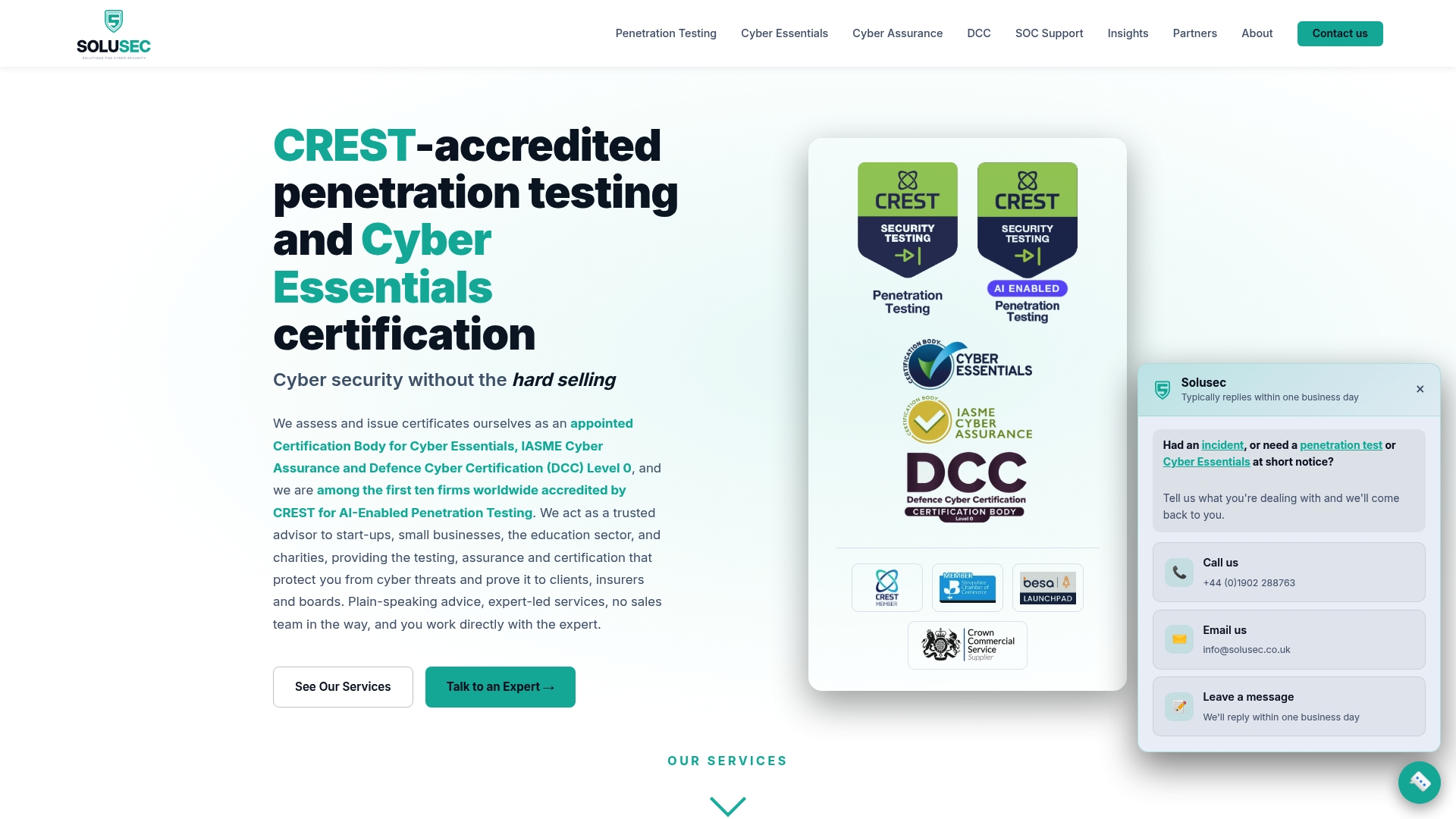
If your external estate needs checking, Solusec’s external IP test starts at £3,000 one off, and a CMS website test runs from £2,500 one off, both with named testers and a sample report available on request before you commit. Businesses needing ongoing assurance rather than a single point-in-time check can look at continuous penetration testing or annual penetration testing arrangements. Cyber Essentials certification is commonly available at prices in the range of a few hundred pounds, with some providers offering urgent turnaround options for an additional fee.
Get in touch through Solusec’s penetration testing page to discuss scope, request a sample report, and get a fixed quote before you decide anything.
Sources
FAQ
What is CREST penetration testing?
It’s a security assessment performed by a company and individual testers accredited against CREST’s technical, ethical, and quality standards. The accreditation is issued per service discipline, so CREST-accredited testing can cover infrastructure, web, mobile, cloud, or AI systems depending on what the provider is specifically accredited for.
What are the top penetration testing companies?
There’s no single official ranking, and CREST doesn’t endorse individual firms above others. The reliable approach is checking the CREST marketplace for accredited suppliers in your required discipline and reviewing a redacted sample report before choosing, rather than relying on generic “top provider” lists.
How much does CREST CRT certification cost?
CRT exam and training costs vary by training provider and aren’t published as a single fixed figure by CREST itself. Candidates need a valid CPSA first and must score at least 60% in both the infrastructure and web application components to pass.
What are the stages of a penetration test?
A typical CREST-quality engagement runs through scoping, discovery and reconnaissance, exploitation, post-exploitation, and reporting. Solusec’s penetration testing engagements follow this structure, with named testers validating findings manually rather than relying on scanner output alone.
Do I need CHECK or CREST for my organisation?
CHECK applies to government, public-sector, and critical national infrastructure systems with clearance and reporting requirements. Most private-sector businesses, schools, and charities should specify CREST accreditation instead, since it covers commercial assurance needs without the clearance overhead.
Recommended
This article was created with assistance of AI. We never use AI with your data unless given explicit permission.