
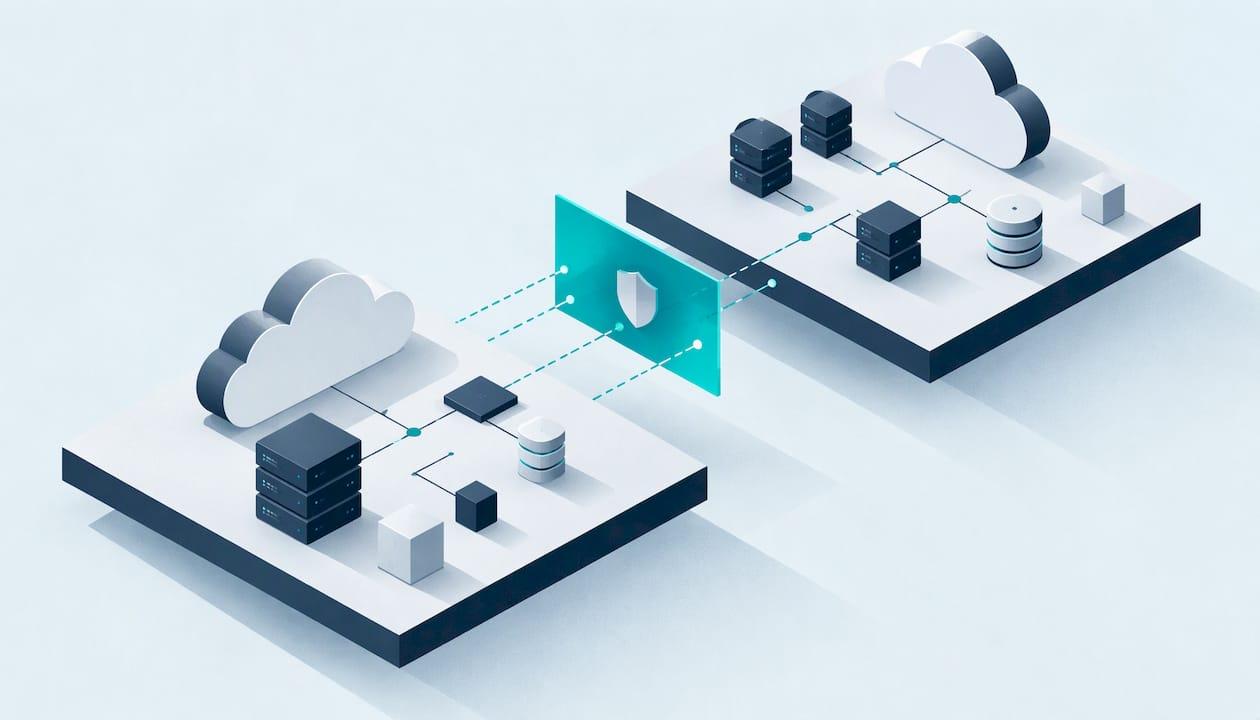
A cloud security review is an independent check of how your AWS, Azure or Google Cloud environment is actually set up, measured against a defined baseline, with a prioritised list of what to fix. It looks at identity, network controls, logging, storage and the code that builds your infrastructure. For most small organisations it is the quickest way to find the settings an attacker would use first.
This guide explains what a review includes, how it differs from a configuration review or an audit, what the UK guidance expects of you, and how to scope one so the findings get fixed.
Key Takeaways
- A cloud security review is a scoped, point-in-time evaluation of your cloud settings against an agreed baseline, ending in prioritised, fixable findings.
- The words review, configuration review, assessment and audit overlap. What matters is the scope, the baseline and whether you need a formal certificate or an internal decision.
- Under NCSC guidance, configuring the services you use securely stays your responsibility, even when the provider's defaults are sound.
- Automation gives breadth and manual checking confirms what a finding means in your environment, so a good review uses both.
- Agree scope and baseline first, then plan the fixes and a retest before you start.
Table of Contents
- What a cloud security review is
- Why configuration is the heart of it
- What a review covers across AWS, Azure and Google Cloud
- How a review is carried out
- What the UK guidance expects of you
- What you should expect back
- Planning a review when you are a small organisation
- Working with Solusec on your cloud review
- FAQ
- Sources
What a cloud security review is
A review looks at the way your cloud account is configured and used, then compares that with a recognised standard. One industry description of a cloud security assessment is a scoped, point-in-time evaluation of an environment against a defined baseline, such as the CIS Benchmarks. The baseline is the yardstick. Without one, "secure" has no meaning.
The review does not test your cloud provider's data centres. Those belong to the provider. It covers what you control: who can log in, what they can do, which services face the internet, where data sits, what gets logged and how changes are made.

Review, configuration review, assessment or audit
Readers search for all of these terms and suppliers use them loosely. A practical way to separate them:
| Term | Typical focus | Usual output |
|---|---|---|
| Cloud security review or assessment | Overall security posture of your cloud estate against a baseline | Prioritised findings and a remediation plan |
| Cloud configuration review | Settings of cloud resources and management interfaces, looking for misconfigurations | List of misconfigurations with fixes |
| Cloud security audit | Checking against a fixed, external standard or regulation | Pass or fail evidence for certification or reporting |
This follows how Fidelis Security draws the line: assessments often inform internal decisions, while audits are run against a fixed external standard and are needed for formal certification and regulatory reporting. Configuration audits sit in between, examining resource settings for misconfigurations.
In practice, most small organisations want the first or second. You want to know what is wrong and what to do next. If a customer, funder or framework demands a formal attestation, you are in audit territory and should ask which standard it names before you commission anything.
Why configuration is the heart of it
The cloud is rarely breached by someone defeating the provider's engineering. It is breached through a storage bucket left open, an over-generous role or a login without multi-factor authentication. The ICO's review of past incidents cites Gartner research finding that 36% of companies suffered a serious cloud security leak and that 99% of firewall breaches were caused by misconfiguration. Both figures are from a 2023 report, so treat them as an indication of scale rather than a current rate.
The NCSC is explicit about who owns this. Even where a provider uses secure-by-default settings, configuring the cloud services you use remains your responsibility. A review is how you check you have done that part properly.

What a review covers across AWS, Azure and Google Cloud
Scope differs by provider, but the layers are the same. Published methodologies describe coverage of identity and access, network controls, logging, storage and infrastructure-as-code across all three major platforms. Another provider's description adds compute workloads and data storage to the list.
Identity and access
This is usually where the most serious findings sit. Reviewers look at:
- Administrator and privileged accounts, and how many there are
- Multi-factor authentication on every human login
- Roles and policies that grant wider permissions than the job needs
- Service accounts, access keys and tokens that are old, shared or never rotated
- Guest and third-party access that was never removed
Least privilege is the guiding principle: each person or system gets only the access it needs.
Network controls
The review checks which services are reachable from the internet and whether they should be. It covers security groups and firewall rules, segmentation between environments, routing, and remote administration ports left open for convenience.
Logging and monitoring
If an incident happens, logs are how you find out what occurred. A review checks that logging is switched on for the right services, that logs are kept long enough, that they are protected from tampering and that someone is alerted when something unusual happens. If you lack the people to watch alerts, our SOC consulting and support can help you decide what to monitor and who responds.
Storage and data protection
Expect checks on public access to storage, encryption at rest and in transit, key management, backups and retention. For organisations holding personal data, this is the section that connects most directly to data protection duties.
Infrastructure-as-code and containers
If your environment is built from templates, the review can examine the templates, so a fix applies to every future deployment rather than one resource. If you run containers, a dedicated Kubernetes security assessment goes deeper than a general cloud review can.
Platform-specific points
In Azure, scope normally includes subscriptions, Entra ID and the Microsoft 365 tenancy. Our guides on Azure penetration testing and Microsoft 365 security assessment explain how those areas are tested. Google Cloud has its own rules of engagement, set out in our piece on Google Cloud penetration testing.
How a review is carried out
The usual lifecycle has five stages: scoping, evidence gathering, testing, finding prioritisation and remediation retesting. In plain terms:
- Scope. Agree which accounts, subscriptions and projects are in, which standard you measure against and who the contacts are.
- Evidence gathering. The reviewer is typically given read-only access, and collects configuration data through the provider's APIs.
- Testing. Settings are compared with the baseline, and suspicious items are examined by hand.
- Prioritisation. Findings are ranked by how likely and how damaging exploitation would be in your environment.
- Retest. After you fix the main issues, the reviewer checks the fixes worked.
Automated and manual work
Configuration and posture checks are primarily automated: tools use API-driven discovery to compare resources against benchmarks, giving broad and repeatable coverage. Automation cannot tell you whether a finding matters. One practitioner view is that manual review is needed to validate the real-world impact of findings in a specific environment. A public test bucket and a bucket holding customer records are the same finding to a scanner and very different problems to you.
This is also why a review is not the same as a vulnerability scan or a penetration test. A review is mainly about configuration and design; a penetration test tries to exploit weaknesses. See our explainer on penetration testing versus vulnerability scanning for the distinction.
What the UK guidance expects of you
UK organisations have clear public guidance to work from, and a review is a sensible way to evidence you followed it.
- NCSC Cloud Security Principles. The NCSC advises using its 14 Cloud Security Principles to analyse cloud services and providers and consider how to configure them securely. A review can be mapped to these principles.
- Provider assurance. Do not expect a public cloud provider to allow bespoke audits, because that would not scale across its customers. The NCSC notes that independent validation may include standards such as SOC 2 and ISO 27001. So you review your own use of the platform and rely on the provider's certificates for the platform itself.
- Procurement and contracts. The ICO advises completing information and cyber security risk assessments before procuring services and making sure supplier contracts include enforceable security requirements.
- Baselines. The ICO's audit framework suggests defining baseline configurations for all cloud services and applications and keeping them under periodic review. Our guide to a secure configuration baseline shows how to build and maintain one.
- Government supply chains. If you supply the Department for Work and Pensions, its cloud computing standard SS-023, dated 26 June 2025, verifies compliance through controls testing, security assurance activities and independent external audit.
If you also hold, or are pursuing, Cyber Essentials, cloud services are in scope of its requirements, so a review is useful preparation. Our Cyber Essentials page explains how certification works.
What you should expect back
A good report is something a non-specialist director can act on. Whatever the supplier, look for:
- A short summary in plain English that says where you stand and what to do first
- Findings ranked by severity, each with the affected resource, why it matters and exactly how to fix it
- A mapping to the baseline used, so you can see what was checked
- A split between quick wins you can do this week and changes needing planning
- A retest to confirm the fixes
Typical findings include accounts without multi-factor authentication, over-broad administrator roles, publicly reachable storage or management ports, logging that is off or short-lived, unencrypted data stores and stale access keys. The ICO's recommended habits apply directly to the fixes: independent "four eyes" checking of changes, changing default account settings, removing unnecessary features and using automation to detect unauthorised baseline changes.
Planning a review when you are a small organisation
Smaller bodies often lack the time or in-house expertise to choose cloud services, set them up securely and keep optimising them. The National Audit Office makes this point, noting that smaller organisations may benefit from the expertise of service companies. A few choices keep a review proportionate.
Agree scope and baseline first
One vendor view is that scoping and landing the findings are where engagements fail, and that the scope and baseline should be agreed before evaluation starts. Write down which accounts are in, which are not and why. Include development and test environments if they connect to production or hold real data.
Start with the crown jewels
If you cannot review everything at once, begin with the environment holding customer data, payment flows or student records, then the accounts with the most administrators. Widen the scope later.
Decide who fixes what
Settle in advance who owns each type of fix: your IT lead, your managed service provider or a developer. If an MSP runs your cloud, think about whether the same party should also judge its own work. Our article on why your MSP is not the best judge of your cyber security covers that question.
Plan for the retest and the next review
A review is a snapshot. Cloud environments change weekly, so book the retest with the review and decide how often to repeat it. Many organisations pair a review with ongoing vulnerability management so new issues are caught between reviews.
Working with Solusec on your cloud review
We are a CREST-accredited provider, and our cloud security assessments cover AWS and Azure environments. You work directly with the testers and assessors doing the work, not a sales team, and we write findings in plain English with proportionate recommendations suited to startups, small businesses, schools, colleges and charities.

If you want a second pair of expert eyes on your configuration, see our cloud security assessment or talk to us through the Solusec site. If you want to go beyond configuration and prove what an attacker could do, our penetration testing starts from the penetration testing page.
FAQ
How long does a cloud security review take?
It depends on the number of accounts, subscriptions and services in scope. A single small environment is a much smaller job than a multi-cloud estate with hundreds of resources. The supplier should give you a timeline once the scope and baseline are agreed.
Is a cloud security review the same as a cloud security audit?
Not quite. A review or assessment usually informs your own decisions and improvements. An audit is normally run against a fixed external standard and produces evidence for certification or regulatory reporting. Check which one a customer or regulator is asking for before you commission work.
Does my cloud provider already review my security?
Your provider secures the underlying platform. Under the NCSC's guidance, configuring the services you use remains your job, and you should not expect a public cloud provider to run a bespoke audit for you. A review checks the part you control.
Do I need access to my cloud account for the reviewer?
Usually yes, in a read-only form. The reviewer collects configuration data through the provider's tools and interfaces, so they can see settings without changing anything. Agree the access and its duration during scoping.
How often should we repeat a review?
Cloud environments change constantly, so a single review ages quickly. Many organisations repeat one annually and after major changes such as a migration, a new platform or a change of supplier. Pairing it with continuous vulnerability management covers the gaps in between.
Sources
- Cloud Security Assessment: A Complete Guide (Orca Security)
- What Is a Cloud Security Audit? (Fidelis Security)
- Cloud Security Assessment Methodology (Cloud Security Partners)
- Cloud Security Assessment: AWS, Azure, GCP (TMG Security)
- Errors (ICO)
- System and network security (ICO)
- IT supplier relationships (ICO)
- Cloud Security Principles (NCSC)
- Principle 14: Secure use of the service (NCSC)
- Choosing a cloud provider (NCSC)
- Security Standard – Cloud Computing SS-023 (DWP)
- Guidance for audit committees on cloud services (National Audit Office)
Recommended
- Cloud Security Assessment: AWS & Azure
- Kubernetes Security Assessment: What It Covers and How to Run One
- Google Cloud penetration testing: scope, rules and cost
- Microsoft 365 Security Assessment: From Secure Score to CREST
This article was created with assistance of AI. We never use AI with your data unless given explicit permission.